09 · API Reference
The complete public API of the rbamp package. Source —
__init__.py (re-exports),
_rbamp_core.py (the main RbAmp class),
_snapshot.py (POD structures + exception
hierarchy), _energy.py (Wh accumulator),
_registers.py (auto-generated constants).
This chapter is a reference: signatures, return values, side effects, edge cases. For working examples go to 06 · Examples; for a quick start, see 05 · Quickstart.
Imports
from rbamp import (
    RbAmp,                     # main class
    RbAmpEnergy,               # Wh accumulator (accessed via dev.energy)
    RbAmpSnapshot,             # RT-block dataclass-style
    RbAmpPeriodSnapshot,       # period snapshot dataclass-style
    RbAmpSensorClass,          # sensor-class enum
    TOPOLOGY_SINGLE, TOPOLOGY_SPLIT_PHASE, TOPOLOGY_THREE_PHASE,
    TOPOLOGY_FIVE_CH, TOPOLOGY_SEVEN_CH,
    topology_name,             # helper: int → topology name
    # STD module line (1.6.0)
    RbAmpStdEnergy, RbAmpStdVoltage, RbAmpStdChannel,
    RbAmpStdConfig, RbAmpStdHealth,   # value objects
    std_energy_delta,          # energy between two read_std_energy() snapshots
    phase_seq_name,            # helper: phase-sequence code → name
    PHASE_SEQ_NA, PHASE_SEQ_FORWARD, PHASE_SEQ_REVERSE, PHASE_SEQ_ABNORMAL,
    # Exception hierarchy
    RbAmpError,                # base class of all errors
    RbAmpIOError,
    RbAmpTimeoutError,
    RbAmpNotReadyError,
    RbAmpStaleError,
    RbAmpParamError,
    RbAmpModeError,
    RbAmpVersionError,
    RbAmpNotSupportedError,    # call not available on this module / firmware
    # Metadata
    __version__,               # "1.6.0"
    __protocol_version__,      # 0x04 (RBAMP_PROTOCOL_VERSION)
    REGISTERS, COMMANDS,       # raw protocol constants (advanced use)
)
Minimal import for a typical application:
from rbamp import RbAmp, RbAmpSensorClass, RbAmpErrorGeneral idioms
The API follows standard Python patterns:
- One class for every module line: the same
RbAmpclass serves BASIC and STANDARD (STD) modules. The line is detected automatically inbegin()(see STD module line); you never choose it. - Class-based: the main
RbAmpclass owns everything — RT readings, period, configuration, diagnostics. The handle holds the backend + energy accumulator internally. - Context manager:
with RbAmp(bus, addr) as dev:— the recommended idiom.__enter__automatically callsdev.begin(). - Properties for RT readings:
dev.voltage,dev.frequency— one property = one I²C transaction. Channel-indexed ones go through_ChannelProxy:dev.current[ch],dev.power[ch],dev.power_factor[ch]. - Methods for channel-indexed reads:
dev.read_current(ch),dev.read_power(ch). Fully equivalent to the property form — use whichever is convenient. - Exceptions for errors: every error is a subclass of
RbAmpError. The standard Pythontry / exceptpattern (notlast_error()+ a return code). - Async generator for periodic streaming:
async for snap in
  dev.stream_period(interval_s=...)
.
Types
RbAmp
class RbAmp:
    def __init__(self, bus, addr: int = 0x50): ...
The main class. One instance per slave device. The bus is any
object with one of the "known" API signatures: smbus2.SMBus,
machine.I2C, or a custom backend (see 04 · Hardware).
The backend is selected automatically on the first bus access:
| bus-object method | Backend |
|---|---|
bus.readfrom_mem, bus.writeto_mem |
MachineI2CBackend (MicroPython) |
bus.read_byte_data, bus.write_byte_data |
SMBusBackend (CPython + smbus2) |
bus.read_byte, bus.register_acks, bus.now_ms |
already-wrapped (test mocks, FTDI adapters) |
If no signature matches, an RbAmpParamError is raised with a
description.
Exception hierarchy
Every error from the package is a subclass of RbAmpError, which
itself inherits from OSError (not bare Exception). This
means: existing code with except OSError: handlers keeps
catching rbAmp errors without any rewrite — the standard Python
convention for hardware-I/O drivers.

Note:
RbAmpParamErrorinherits fromRbAmpError+ValueErroron CPython (multi-base). On MicroPython, where multi-base inheritance is not supported by all ports, it falls back to single-base. From the user's point of view,try / except RbAmpParamErrorworks the same way. Buttry / except ValueErrorcatches only on CPython — on MicroPython this handler is missed. Code that relies on cross-platform behavior must catchRbAmpParamErrorexplicitly.
Standard usage:
try:
    snap = dev.read_period_snapshot()
except RbAmpStaleError:
    # period not ready yet — the master timestamp was committed by the package
    continue
except RbAmpIOError as e:
    log.warning("bus failure: %s", e)
except RbAmpError as e:
    log.error("unexpected: %s", e)
RbAmpSensorClass
class RbAmpSensorClass(IntEnum):
    UNSET       = 0   # factory value after reset
    SCT_013     = 1   # SCT-013 series (shipping default)
    WIRED_CT    = 2   # factory-fitted wired CT (module ships paired)
BUILTIN_CT = 3 # factory-fitted built-in CT (module ships paired)Note: on CPython,
IntEnumfrom the stdlibenumis used. On MicroPython ports without anenummodule, a plain-class fallback with the same member values is used. From the user's point of view the two forms are identical:dev.set_sensor_class(RbAmpSensorClass.SCT_013)ordev.set_sensor_class(1)— both work.
SCT_013 is the class you select on a module with user-fitted
SCT-013 clamps. WIRED_CT and BUILTIN_CT describe modules that are
delivered factory-paired with their sensor: set_sensor_class() and
set_ct_model*() refuse to change such a module (RbAmpModeError, see
read-before-write guard). Values outside
0..3 raise RbAmpParamError.
RbAmpSnapshot
Returned by dev.read_all(). A plain Python class (not a
@dataclass, for MicroPython compatibility). All fields in SI units.
class RbAmpSnapshot:
    voltage:        float       # V — RMS voltage
    voltage_peak:   float       # V — peak voltage
    current:        list        # [ch0, ch1, ...] — RMS current per channel, A
    current_peak:   list        # [ch0, ch1, ...] — peak current, A
    power:          list        # [ch0, ch1, ...] — active power (signed), W
    power_factor:   list        # [ch0, ch1, ...] — dimensionless, −1..+1
    frequency:      float       # Hz
    topology:       int         # TOPOLOGY_* constant
    channels:       int         # number of valid channels (1..3, or 5 / 7 on UI5 / UI7)
    has_voltage_hw: bool        # True if a voltage sensor is present
Unused channels (beyond channels) are filled with zeros.
RbAmpPeriodSnapshot
Returned by dev.read_period_snapshot(). The energy-accounting
primitive.
class RbAmpPeriodSnapshot:
    avg_p:        list   # [ch0, ch1, ...] — average P over the period, W (all channels)
    max_p:        float  # peak instantaneous power on channel 0
    latch_ms:     int    # period duration (device's view)
    master_dt_ms: int    # master wall-clock dt since the last snapshot
    valid:        bool   # True if the snapshot-ready flag was set
    avg_p_total:  float  # STD: total average P over the period, W (0.0 on BASIC)
    wh_net:       float  # STD: net energy over the period, Wh (0.0 on BASIC)
    module_restarted: bool  # STD counter source: the module restarted during the period
For energy integration, use
master_dt_ms, notlatch_ms—latch_msis a module diagnostic timer.
Topology constants
TOPOLOGY_SINGLE      = 1   # 1 current channel (UI1 / I1)
TOPOLOGY_SPLIT_PHASE = 2   # 2 current channels (UI2 / I2)
TOPOLOGY_THREE_PHASE = 3   # 3 current channels (UI3 / I3)
TOPOLOGY_FIVE_CH     = 5   # 5 current channels + voltage (UI5)
TOPOLOGY_SEVEN_CH    = 7   # 7 current channels + voltage (UI7)
topology_name(topology: int) -> str   # 1 → "SINGLE", 2 → "SPLIT_PHASE", ...
Lifecycle
RbAmp(bus, addr=0x50)
Constructor. Backend resolution happens in __init__. No I²C
traffic is generated until begin().
| Parameter | Description |
|---|---|
bus |
I²C bus object (smbus2.SMBus, machine.I2C, or a wrapper) |
addr |
7-bit slave address. Range 0x08..0x77, default 0x50 |
Raises: RbAmpParamError if the bus object is not recognized or
addr is out of range.
dev.begin()
Native protocol: 02 · Initialization and Start-up (initialization) · BASIC or STD? (initialization) · Continuous polling cycle (recommended) (period-metering)
Probes the device + detects the module line + caches topology + primes the snapshot command.
Module-line detection (1.6.0). begin() first checks whether the
module is an STD module (16-bit register map). If it is, the handle
switches to STD mode (dev.is_std becomes True, dev.channels and
dev.has_voltage_hw come from the module) and begin() returns. If
not, the BASIC sequence below runs. This needs a bus backend that can
do 16-bit transactions; otherwise the module is treated as BASIC.
BASIC sequence:
- Reads
REG_VERSION— raisesRbAmpIOErroron NACK,RbAmpVersionErrorif0x00/0xFFis returned. - Caches topology (on the current firmware,
begin()does no auto-probe; it uses the hint from the constructor). - Reads
U_rmsto determine whether a voltage sensor is present (threshold 1.0 V). - Writes
CMD_LATCH_PERIOD(primer) + waits 50 ms. The first snapshot after power-up is discarded. - Stores
time.monotonic()(ortime.ticks_ms()on uPy) for subsequent energy integration.
On a BASIC module with SCT-013 clamps, begin() also evaluates the
SCT-013 rating-switch correction.
Idempotent: safe to call repeatedly.
Context manager
with RbAmp(bus, 0x50) as dev:
    # dev.begin() has already been called in __enter__
    ...
# __exit__ — no-op (bus closing is the caller's responsibility)
The recommended idiom. The package's __exit__ does NOT close the
bus — managing the bus object remains the caller's job (the typical
pattern is nested with SMBus(1) as bus, RbAmp(bus, 0x50) as dev:).
dev.probe() -> bool
A lightweight liveness check. A single REG_VERSION read with no
side effects.
Returns: True if the slave ACKed and reported a supported
version; False otherwise. Does not raise — for polling
scenarios.
dev.wait_ready(timeout_ms=1000) -> None
Native protocol: 02 · Initialization and Start-up (initialization) · 3.
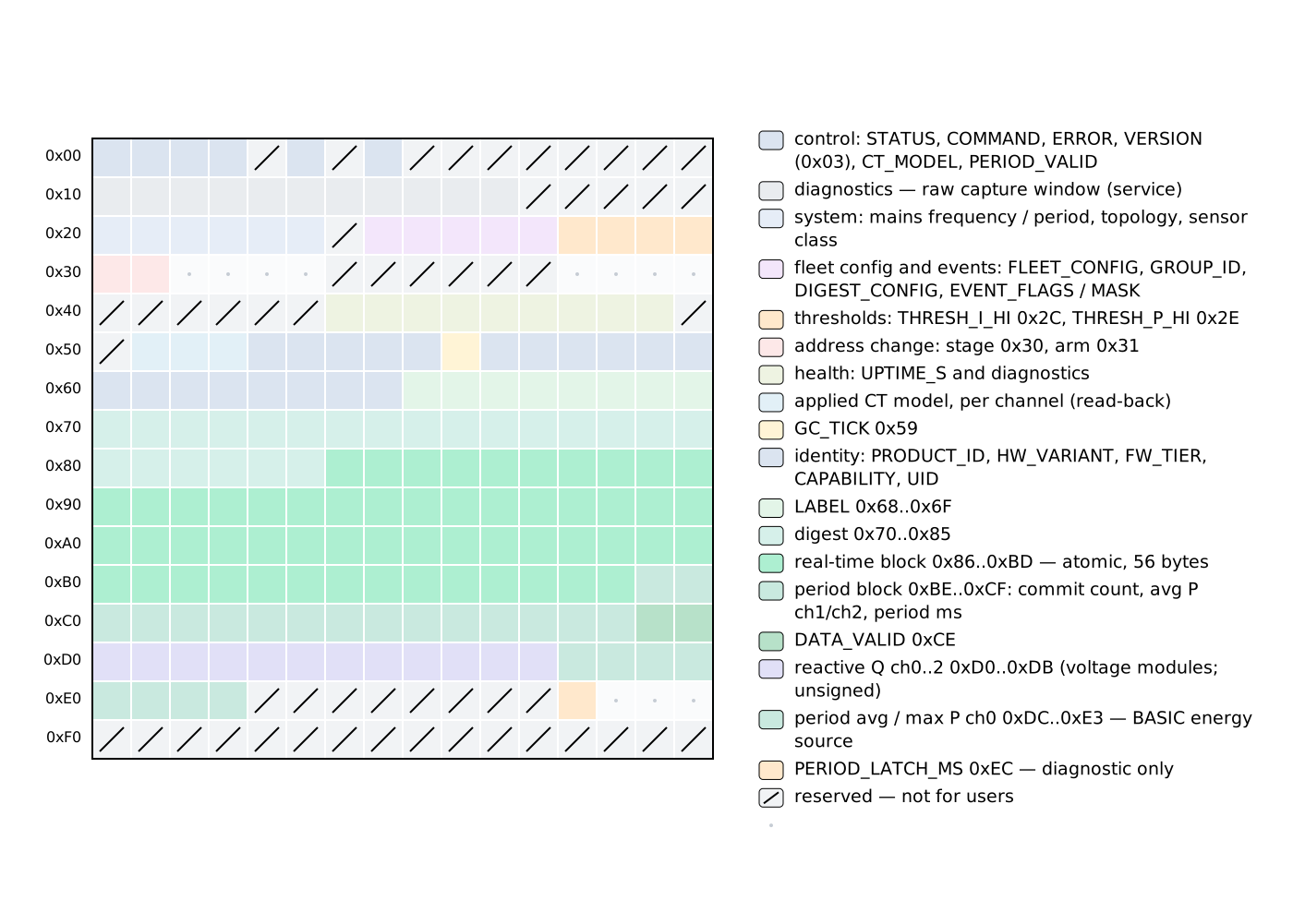
DATA_VALID(0xCE) never becomes 1 (troubleshooting) · 4 · Register map (production v1.3) (api-reference)
Polls the module's ready flag until it is set. Useful after power-up — the module may need up to 100 ms for its first RT window.
Raises: RbAmpTimeoutError if the bit is not seen before
timeout_ms elapses.
Properties — handle state
Native protocol: BASIC or STD? (initialization) · Multi-channel current (UI2 / UI3 / UI5 / UI7) (realtime-polling) · 4.10 V03 real-time block (0x86..0xBD) (api-reference)
dev.firmware_version: int      # REG_VERSION — opaque byte
dev.topology:         int      # TOPOLOGY_* constant
dev.topology_name:    str      # "SINGLE" / "SPLIT_PHASE" / "THREE_PHASE"
dev.channels:         int      # 1..3 (BASIC), 5 / 7 on UI5 / UI7, or the STD module's channel count
dev.is_std:           bool     # True if begin() detected an STD module
dev.has_voltage_hw:   bool     # True if begin() detected U_rms > 1.0
dev.address:          int      # 7-bit I²C address (updated after commit_address_change)
firmware_version is a live property: every read hits the
bus (one single-byte read of REG_VERSION). Cache it on the
application side if you poll it in a hot loop:
fw = dev.firmware_version once after begin(). If begin()
has not been called yet, firmware_version raises RbAmpIOError
(the module may NACK while the handle is "cold").
The remaining properties (topology, channels, has_voltage_hw,
address) are cached in the handle and return the values stored
after begin() without hitting the bus.
Real-time readings (RT block, 100 ms update)
All methods raise RbAmpIOError on a communication failure (NACK
after retry or sanity reject) or RbAmpParamError on an invalid
argument.
Properties
Native protocol: Multi-channel current (UI2 / UI3 / UI5 / UI7) (realtime-polling) · 4.14 Channel access window (
0x32+0x3C..0x3F) (api-reference)
dev.voltage         -> float   # V — RMS voltage
dev.voltage_peak    -> float   # V — peak voltage
dev.frequency       -> float   # Hz — mains frequency
Channel-indexed through _ChannelProxy — supports [ch]
indexing and iteration:
dev.current         # _ChannelProxy → dev.current[0], dev.current[1], ...
dev.current_peak    # _ChannelProxy
dev.power           # _ChannelProxy
dev.power_factor    # _ChannelProxy
Usage:
i0 = dev.current[0]                       # a single channel
for i in dev.current:                      # iterate over all valid channels
    print(i)
total = sum(p for p in dev.power)          # sum of all channels
len(dev.current) equals dev.channels.
Methods (fully equivalent to the property form)
Native protocol: RT register reference (realtime-polling) · Bidirectional accounting (period-metering)
dev.read_voltage(phase=0)         -> float
dev.read_voltage_peak(phase=0)    -> float
dev.read_current(ch=0)            -> float
dev.read_current_peak(ch=0)       -> float
dev.read_power(ch=0)              -> float       # signed
dev.read_power_factor(ch=0)       -> float
dev.read_frequency()              -> float
One-shot read of the entire RT block
Native protocol: RT register reference (realtime-polling) · Polling — single module (realtime-polling) · 4.10 V03 real-time block (0x86..0xBD) (api-reference)
dev.read_all() -> RbAmpSnapshotEquivalent to consecutive read_voltage + read_voltage_peak +
read_current(0..N) + read_current_peak(0..N) + read_power(0..N) +
read_power_factor(0..N) + read_frequency. Unused channels
(beyond channels) are filled with zeros.
Raises: RbAmpIOError if any sub-read fails.
The common readers — voltage, voltage_peak, current, current_peak,
power, power_factor, frequency and their read_* forms — work on
every module line. On an STD module phase in read_voltage() /
read_voltage_peak() selects the voltage input
(0..n_voltage-1); on a BASIC module only phase=0 is valid.
STD module line (1.6.0)
⚠️ Validation status. The on-device energy, voltage-angle and starting-current features are validated on CPython (
smbus2). The same calls are implemented for MicroPython (machine.I2C), but the MicroPython 16-bit path is not yet hardware-validated — prefer CPython for these on-device features until a release note says otherwise. The common readings (dev.voltage,dev.current[ch],dev.power[ch], period snapshots) work on every supported host regardless.
A single RbAmp class serves both module lines. begin() detects the
line automatically; dev.is_std is True on an STD module. The same
I²C wiring and address are used (see 04 · Hardware).
- The common readers (
voltage,current,power,power_factor,frequency) work on any module. - The calls in this section are STD-only. On a BASIC module they raise
RbAmpNotSupportedError. - Some STD calls also need a recent enough module image (on-device energy,
micro-unit counters, voltage angles, starting current). If the module
does not provide them the call raises
RbAmpNotSupportedError("not available"). - The period calls (
latch_period,read_period_*,stream_period) and thedev.energyaccumulator work on an STD module — see "Period accounting" below. The module's own lifetime totals areread_std_energy(). - The sensor configuration calls (
set_sensor_class,set_ct_model,set_ct_model_ch,set_ct_model_ch_force,read_ct_model_ch,read_sensor_class),reset,factory_reset, the address-change pair, the identity registers (firmware_version,read_variant,read_capability,read_product_id,read_uid,read_label,set_label,read_seq_digest), the error / event channel (read_last_error,read_event_flags,clear_event_flags,has_error,clear_error), the fleet helpers (read_fleet_config,enable_gc,set_group_id,read_group_id,read_gc_tick),read_period_latch_msandwait_readyare BASIC only: on an STD module they raiseRbAmpNotSupportedErrorbefore anything is sent on the bus.
dev.is_std        -> bool   # True on an STD module (set by begin())
dev.std           -> object # internal STD client (advanced use) or None on BASIC
Readers
dev.read_std_voltage(phase=0)    -> RbAmpStdVoltage   # RMS, peak, THD, angle
dev.read_voltage_angle(phase=0)  -> (float, bool)     # (degrees, valid)
dev.read_phase_sequence()        -> int               # 0..3
dev.read_std_channel(ch=0)       -> RbAmpStdChannel   # I / P / Q / S / PF + harmonics
dev.read_std_totals(k=0)         -> RbAmpStdChannel   # totals block k (0 = grand total)
dev.read_reactive(ch=0)          -> float             # var
dev.read_apparent(ch=0)          -> float             # VA
dev.read_std_config()            -> RbAmpStdConfig
dev.read_std_health() -> RbAmpStdHealthread_voltage_angle(phase)— voltage phase angle relative to phase 0, returned as(degrees, valid).validisFalseon a single-voltage module or on a module image that does not report angles.read_phase_sequence()— phase-sequence code:PHASE_SEQ_NA(0, not available),PHASE_SEQ_FORWARD(1),PHASE_SEQ_REVERSE(2),PHASE_SEQ_ABNORMAL(3).phase_seq_name(code)returns the text name. RaisesRbAmpNotSupportedErroron a BASIC module or on a module image that does not report it.read_reactive(ch)/read_apparent(ch)— reactive power in var and apparent power in VA for one channel. STD modules only; on a BASIC module they raiseRbAmpNotSupportedError(on BASIC, reactive power is not exposed by this library).read_std_totals(k)— totals blockk;k=0is the grand total. Per-phase totals depend on the module's register map version.read_std_config()/read_std_health()— configuration and status/health blocks.
Value objects
Plain classes (not @dataclass), all re-exported from rbamp.
| Class | Fields |
|---|---|
RbAmpStdVoltage |
u_rms, u_peak, thd_u, angle_deg, angle_valid |
RbAmpStdChannel |
i_rms, i_peak, p, q, s, pf, thd_i, pf1, q1 |
RbAmpStdConfig |
sensor_class, ct_model, tier, i2c_addr, rate_ms, harmonics, start_ua, start_ua_supported |
RbAmpStdHealth |
status, cal_ok, sensor_ok, mains_ok, time_valid, nvm_fault, maint, frame_count, crc_errors, lta_status, lta_src, cal_src, group_status, ring_drop, lost_frames, uptime_s, reset_cause, boot_count |
RbAmpStdEnergy |
see below |
dev.read_std_energy() -> RbAmpStdEnergy
Native protocol: Bidirectional accounting (period-metering)
On-device lifetime energy snapshot. Requires a module that provides
on-device energy; otherwise RbAmpNotSupportedError.
RbAmpStdEnergy carries:
| Group | Fields |
|---|---|
| Active, Wh | act_import_wh, act_export_wh, act_net_wh |
| Active, mWh | act_import_mwh, act_export_mwh, act_net_mwh |
| Active, µWh | act_import_uwh, act_export_uwh, act_net_uwh |
| Reactive | rea_import_varh, rea_export_varh; µvarh: rea_import_uvarh, rea_export_uvarh |
| Per channel | channels (count of valid entries); ch_import_mwh[], ch_export_mwh[], ch_import_uwh[], ch_export_uwh[] |
| Bookkeeping | generation, uptime_s, group_status |
| Provenance flags | fine, fine_reactive |
The µWh / µvarh fields are always populated. When the module image does
not provide the finer counters, they are scaled up from the coarser ones
and fine (active) / fine_reactive are False — read the flag if you
need to know where the value came from.
RbAmp.std_energy_delta(prev, now) -> (delta, module_restarted)
Energy consumed between two read_std_energy() snapshots (static
method; also exported as std_energy_delta). Power-cut-safe.
module_restartedisTruewhennow.uptime_s < prev.uptime_s.deltais anRbAmpStdEnergyholding the per-field increase, orNonewhen thegenerationcounter changed (the two readings are not comparable).- A counter that comes back slightly below the previous reading (resume
after a power cut) is clamped to 0;
netis always import − export of the clamped parts. - Per-channel entries are filled only when both snapshots carry the same channel count.
prev = dev.read_std_energy()
time.sleep(60)
now = dev.read_std_energy()
delta, restarted = RbAmp.std_energy_delta(prev, now)
if delta is not None:
    print(delta.act_import_wh, "Wh imported in this interval")
Starting current and configuration
dev.get_start_current()     -> int    # µA, 0 = off
dev.set_start_current(ua)   -> None
dev.save_config()           -> None   # persist writable STD config to flash (blocking)
dev.set_time(unix_epoch) -> None # set the module's clockget_start_current()— the energy starting current in µA (0= off).set_start_current(ua)— below this per-channel current the module does not count energy into import/export; the live readings (I, P, Q) are unaffected. The value applies at once; callsave_config()to keep it across a restart. An unsupported value raisesRbAmpParamErrorbefore anything is written to the bus. The value must be0(off) or a multiple of 10 µA within the supported range.save_config()— persists the writable STD configuration. Blocking.set_time(unix_epoch)— sets the module's clock from a Unix epoch; an epoch before 2020 raisesRbAmpParamError. Set the time again after a module restart (read_std_health().time_validisFalseuntil the clock is set).get_start_current()/set_start_current()raiseRbAmpNotSupportedErroron a module image that does not provide the starting-current setting;RbAmpStdConfig.start_ua_supportedshows whether it does.
Latch banks
An STD module that reports latch banks keeps 8 independent banks. A bank
accumulates while its bit is set in the arm mask; a latch snapshots and
resets it at the next measurement-window boundary, so a period is the
interval between two latches of the same bank, measured by the master's
clock. These calls need a module that reports banks and raise
RbAmpNotSupportedError otherwise; a bank number outside 0..7 raises
RbAmpParamError.
dev.std_arm_banks(mask)                 -> None            # bit i = bank i accumulates
dev.std_latch(bank)                     -> None            # snapshot + reset; does not wait
dev.std_read_latch(bank)                -> RbAmpStdLatch
RbAmp.std_latch_wh(snap, dt_ms, ch=0xFF) -> (wh_import, wh_export)std_arm_banks(mask)— sets the arm mask. The mask is not kept across a module restart.std_latch(bank)— latches one bank. Read it no sooner than 300 ms later.std_read_latch(bank)— returns the bank's snapshot. The module's valid flag only says the bank has been latched at least once; it is not a freshness flag, so wait at least one window (300 ms is a safe bound) afterstd_latch(). A bank that was never latched raisesRbAmpStaleError. An empty bank that is no longer armed (the module restarted) is re-armed and latched once to start a fresh period, and the call raisesRbAmpStaleError: drop that period and restart your own time reference.RbAmp.std_latch_wh(snap, dt_ms, ch=0xFF)— converts the snapshot's energy to Wh overdt_msof the master's clock.chis a channel index, or0xFF(default) for the module total. Returns(wh_import, wh_export); export is zero or negative. RaisesRbAmpStaleErrorfor a snapshot with no samples.
class RbAmpStdLatch:
    bank:       int     # 0..7
    valid:      bool    # the bank has been latched at least once
    channels:   int
    p_avg, q_avg, s_avg: float     # average P (W), Q (var), S (VA) over the period
    max_p, max_i, max_u, min_u: float   # peak P (W), peak I (A), peak / minimum U (V)
    e_import_mws, e_export_mws: int     # energy, mW·samples (export <= 0)
    nsamp:      int     # samples in the period
    win_count:  int     # measurement windows in the period (0 = not armed / nothing elapsed)
    p_avg_ch:   list    # per-channel average P, W
    e_import_ch_mws, e_export_ch_mws: list   # per-channel energy, mW·samples
Period accounting
See 01 · Overview for the big picture and 05 · Quickstart Step 5 for a minimal template.
On an STD module the same calls work. begin() picks the period
source from what the module reports:
| Module reports | Period source | Latch command |
|---|---|---|
| on-device energy counters | difference of two counter readings on the master's schedule | none |
| latch banks only | latch-to-latch on bank 0 (at least 300 ms settle) | CMD_LATCH_PERIOD on bank 0 |
| neither | — | the period calls raise RbAmpNotSupportedError |
On the counter source the first period starts at begin(), latch_period()
does nothing, is_period_valid() is True once the counters are anchored,
read_period_max_power() raises RbAmpNotSupportedError (no peak), and
read_period_avg_power(ch) exists only on a single-channel module, after one
period has been read. A counter generation change re-anchors the period and
raises RbAmpStaleError; a module restart inside a period is reported in
snap.module_restarted (energy is not metered while the module restarts).
On the latch source an empty snapshot raises RbAmpStaleError; if the bank
had lost its arm (module restart) it is re-armed first. The snapshot carries
avg_p_total, wh_net and module_restarted. read_period_latch_ms() is
BASIC only.
dev.latch_period() -> None
Native protocol: 04 · Period Metering and Tariff Accounting (period-metering)
Writes CMD_LATCH_PERIOD. Does not wait — the caller must allow the
50 ms settle and check dev.is_period_valid() before reading.
For most tasks, use read_period_snapshot() — it encapsulates the
whole sequence.
dev.is_period_valid() -> bool
Native protocol: 04 · Period Metering and Tariff Accounting (period-metering) · Calibration and accuracy (troubleshooting)
Reads the snapshot-ready bit. Returns True if the last snapshot is
fresh.
dev.read_period_avg_power(ch=0) -> float
Native protocol: Period snapshot registers (period-metering) · 4.11 V03 period block (0xBE..0xCF) (api-reference) · 4.12 V03 Q + period ch0 (0xD0..0xE3, production build) (api-reference)
Average active power on a channel over the closed period. Must be
called after latch_period() + a 50 ms settle + a valid check.
Resolves every channel of the module (ch = 0..channels-1), including
channels 3+ on 5- and 7-channel modules (UI5 / UI7). The period snapshot and
the Wh accumulator cover all channels as well. dev.read_period_avg_p(ch)
is an alias with the same behaviour.
dev.read_period_max_power() -> float
Native protocol: Period snapshot registers (period-metering) · 4.12 V03 Q + period ch0 (0xD0..0xE3, production build) (api-reference)
Peak instantaneous power on channel 0 over the closed period.
ch=0 only on v1 firmware.
dev.read_period_latch_ms() -> int
Native protocol: 13. Multi-module clock drift in long tests (troubleshooting) · 4.13 Diagnostic chip-side dt (0xEC) (api-reference)
Period duration from the device's perspective, in ms.
Diagnostic value. The module's internal timer has limited accuracy. For energy integration, use
master_dt_msfromRbAmpPeriodSnapshot, not this field.
dev.read_period_snapshot(settle_ms=50, skip_latch=False) -> RbAmpPeriodSnapshot
Native protocol: Continuous polling cycle (recommended) (period-metering) · Calibration and accuracy (troubleshooting) · 4.11 V03 period block (0xBE..0xCF) (api-reference)
The recommended entry point for period accounting. The full sequence under the hood:
- If
skip_latch=True— skip the snapshot command write (for the multi-module pattern after a manual series of snapshot commands). - Otherwise — write
CMD_LATCH_PERIOD. - Capture
time.monotonic()to computemaster_dt_ms. time.sleep(settle_ms / 1000)— 50 ms by default.- Check the snapshot-ready flag. If 0 — raise
RbAmpStaleError(the previous timestamp is kept, so the next successful snapshot covers the full interval and Wh stays exact). - Read
avg_p[0..channels-1]+max_p+latch_ms. - Update the timestamp + call
energy.tick(snap)to integrate Wh (unless the accumulator is disabled viaenergy.disable()).
| Parameter | Description |
|---|---|
settle_ms |
Wait after the snapshot command, in ms. Default 50. |
skip_latch |
If True — do not send the snapshot command, only read. |
Raises: RbAmpStaleError (snapshot stale); RbAmpIOError
(bus failure).
async dev.stream_period(interval_s=60.0, skip_stale=True)
An async generator that yields RbAmpPeriodSnapshot at the
interval_s interval. Works on CPython asyncio and MicroPython
uasyncio (MicroPython ≥ 1.20 — import asyncio also works; for
earlier versions use import uasyncio as asyncio).
async for snap in dev.stream_period(interval_s=60.0):
    # snap is an RbAmpPeriodSnapshot, .valid guaranteed True (by default skip_stale=True)
print(snap.avg_p[0])| Parameter | Description |
|---|---|
interval_s |
Period between snapshots (≥ 30 s recommended) |
skip_stale |
True (default) — stale snapshots are skipped automatically. False — they are yielded with snap.valid=False, and your code must check if not snap.valid: continue itself |
⚠ CPython: blocks the event loop. Under the hood,
stream_period()calls the synchronous, blockingread_period_snapshot()— which does atime.sleep(0.05)settle plus ~50–100 ms of single-byte reads over the bus. On CPython this blocks the entireasyncioevent loop for those 100 ms — other coroutines (MQTT, HTTP, Wi-Fi keepalive) get no CPU. For production servers, wrap it inrun_in_executor:```python import asyncio
async def stream_period_nonblocking(dev, interval_s=60.0): loop = asyncio.get_event_loop() while True: await asyncio.sleep(interval_s) snap = await loop.run_in_executor(None, dev.read_period_snapshot) if snap.valid: yield snap ```
On MicroPython the problem is smaller — the uasyncio scheduler yields to other tasks less often, and blocking I²C is considered acceptable in embedded async patterns. If you need non-blocking behavior, use a separate thread via
_thread.start_new_thread(on ESP32 µPy).
Energy accounting (master-side accumulator)
dev.energy — RbAmpEnergy instance
Native protocol: Master-side algorithm (period-metering) · 7 · Semantics (api-reference)
A per-channel Wh accumulator. Accessed through a property — the package owns the instance:
dev.energy.wh(ch=0)         -> float    # current Wh total for the channel
dev.energy.reset(ch=0)      -> None     # zero a single channel
dev.energy.reset_all()      -> None     # zero all channels
dev.energy.is_enabled       -> bool     # True while auto-integration is active (default)
dev.energy.disable()        -> None     # turn off auto-integration
dev.energy.enable()         -> None     # turn it back on
The accumulator is updated automatically on every successful
dev.read_period_snapshot(). It is signed — a negative value means
net export.
Integration formula:
wh[ch] += snap.avg_p[ch] × master_dt_ms / 1000 / 3600
         [W]             [milliseconds]              → [Wh]
dev.energy.disable() is useful for deep-sleep scenarios where the
master itself owns the Wh persistence in RTC memory — see
06 · Examples, Scenario 9.
Sensor configuration
A two-step sequence. For a detailed model-selection guide, see 03 · Current sensor selection.
dev.set_sensor_class(cls) -> None
Native protocol: Setting the sensor class and CT model (initialization) · 4.3 System (0x20..0x25) (api-reference) · 6.2 CT model binding — pure staging + per-channel CMD (api-reference)
Sets the current-sensor class and saves it to flash. Blocking, ~705 ms.
dev.set_sensor_class(RbAmpSensorClass.SCT_013)
# or equivalently:
dev.set_sensor_class(1)| Parameter | Description |
|---|---|
cls |
An RbAmpSensorClass enum or an int 0..3 |
Raises:
RbAmpParamError—clsoutside 0..3RbAmpModeError— the module is factory-paired (current classWIRED_CT/BUILTIN_CT) andclsdiffers; changing it would clear the fitted-sensor calibrationRbAmpIOError— communication failure
Must be called before set_ct_model*(). Writing the same class the
module already holds is a no-op (no bus write), because a class write
clears the per-channel CT models device-side. See
read-before-write guard.
dev.read_sensor_class() -> int
Native protocol: 4.3 System (0x20..0x25) (api-reference)
Reads the pinned sensor class: 0 UNSET, 1 SCT_013, 2 WIRED_CT,
3 BUILTIN_CT (the RbAmpSensorClass values). Reads 0 on firmware
where the register is not present.
dev.set_ct_model(code) -> None
The single-parameter (legacy) form — sets the CT-clamp model on channel 0 only.
code |
Model |
|---|---|
| 1 | SCT-013-005 |
| 2 | SCT-013-010 |
| 3 | SCT-013-030 |
| 4 | SCT-013-050 |
| 5 | SCT-013-100 |
| 6 | SCT-013-020 |
| 7 | SCT-013-060 |
The accepted set for the
SCT_013class is{1, 2, 3, 4, 5, 6, 7}. The full per-class accept-set table is in 03 · Current sensor selection.
Raises:
ValueError(and alsoRbAmpParamError) —codenot in the per-class accept-set for the currentREG_SENSOR_CLASS(forSCT_013this is{1, 2, 3, 4, 5, 6, 7})RbAmpModeError— ifset_sensor_class()was not called, or the module is factory-paired (class 2/3) and the code differs (useset_ct_model_ch_force()in a service context)RbAmpIOError— communication failure
Setting the model the channel already holds is a no-op (read-before-write guard).
RbAmpModeError message (class unset):
REG_SENSOR_CLASS is UNSET;
call dev.set_sensor_class(RbAmpSensorClass.SCT_013) first
Equivalent to dev.set_ct_model_ch(0, code).
dev.set_ct_model_ch(channel, code) -> None
Native protocol: Setting the sensor class and CT model (initialization) · 6.2 CT model binding — pure staging + per-channel CMD (api-reference)
The per-channel form. Sets the CT-clamp model on a specific channel.
Under the hood: stage REG_CT_MODEL (0x05) → command
CMD_SET_CT_MODEL_CH0/1/2 (opcode 0x28/0x29/0x2A) → 5 ms settle →
CMD_SAVE_USER_CONFIG (0x32) → 700 ms. Blocking, ~705 ms.
✅ v1.3: channel-binding order does not matter . On v1.3, writing
REG_CT_MODEL (0x05)stages the value but no longer applies it automatically to ch0. Application happens only throughCMD_SET_CT_MODEL_CHn. You can configure channels in any order.
python
dev.set_ct_model_ch(0, 1)  # any order is OK on v1.3
dev.set_ct_model_ch(1, 3)
dev.set_ct_model_ch(2, 6)
Raises:
RbAmpParamError—channelout of 0..dev.channels-1orcodenot in the per-class accept-set (forSCT_013—{1, 2, 3, 4, 5, 6, 7})RbAmpModeError—set_sensor_class()not called, or the module is factory-paired and the code differs
dev.set_ct_model_ch_force(channel, code) -> None
Service-path variant of set_ct_model_ch() that bypasses the
read-before-write guard: it writes even when the module is factory-paired
or already holds the code. Intended for technicians re-sensoring a unit.
The module still validates the (class, code) pair and the call raises
RbAmpParamError for a bad pair.
Read-before-write guard
Writing a CT model replaces that channel's calibration with the generic preset for the model, so since 1.6.0 the setters check first:
| Call | Module already holds the value | Factory-paired module (class 2/3) | Otherwise |
|---|---|---|---|
set_sensor_class(cls) |
no-op, no bus write | RbAmpModeError if cls differs |
writes + saves |
set_ct_model(code) / set_ct_model_ch(ch, code) |
no-op, no bus write | RbAmpModeError if the code differs |
writes + saves |
set_ct_model_ch_force(ch, code) |
writes | writes | writes |
V2 verify mirrors — CT_MODEL_CH0/1/2 (0x51-0x53)
Read-only registers reflecting the CT preset actually applied on each channel. The write wire-protocol does not change — writes use the mechanism above. 0x51-0x53 are merely a read-back for state checks and read-compare-write patterns:
applied_ch0 = dev.read_ct_model_ch(0)   # what is actually applied
applied_ch1 = dev.read_ct_model_ch(1)
applied_ch2 = dev.read_ct_model_ch(2)
SCT-013 rating-switch correction
SCT-013 modules are calibrated at the factory with one reference clamp
model. When a channel is switched to a different model, a module image that
does not rescale by itself keeps applying the reference gain, so current and
power would be read at the wrong scale. Since 1.6.0 the library corrects
this automatically on BASIC modules with sensor class SCT_013:
- Current, power and the energy derived from power (
read_current,read_current_peak,read_power,read_period_avg_power, and so the period snapshot anddev.energy) are corrected to the chosen model, relative to the gain the module actually applies. - Voltage and power factor are never changed.
- On module firmware up to 1.4.19 a model change restarts the module once (about a second); from 1.4.20 the module corrects itself. The SCT rating correction scales current, power and energy, never voltage or power factor.
- Modules whose firmware performs this itself are detected and left alone (scale 1).
- Factory-paired modules (class 2/3) are never scaled.
- The correction is evaluated in
begin()and again after a restart the library drives (reset()) or a detected restart. In one situation (a model written during the current power cycle) the library may issue one module reset to read the stored gain.
dev.set_rating_correction(enabled: bool)  -> None   # default enabled
dev.rating_correction_enabled             -> bool
dev.ct_rating_scale(ch=0)                 -> float  # scale currently applied (1.0 = none)
dev.ct_rating_status(ch=0)                -> (action, detail) | None
dev.refresh_rating_correction() -> Noneset_rating_correction(enabled)— turn the correction off to read the raw, uncorrected values (or on a module whose firmware already corrects). Recomputes immediately.ct_rating_scale(ch)— the scale applied to current/power/energy on a channel;1.0when no correction is active.ct_rating_status(ch)—(action, detail)of the last evaluation for a channel, orNoneif the channel was never evaluated (for example not an SCT channel).actionis one of"unity","ok","needs_reset","warn_uncal","warn_gain";detailis text. Thewarn_*actions mean the library could not determine a safe scale and left the reading uncorrected.refresh_rating_correction()— re-evaluate after a restart the library did not drive (for example a model saved and the module reset externally).
This is a feature of the SCT-013 path in all rbAmp libraries, not specific to Python.
dev.save_gains() -> None
A "bare" CMD_SAVE_GAINS (0x26) write — factory-only.
⛔ BLOCKED in production firmware (v1.3 returns
DEV_ERR_PARAM; the device rejects the write and a subsequent reboot reverts any RAM-side change).CMD_SAVE_GAINSis reserved for the factory-provisioning mode and persists gains / NF / phase coefficients only. For user-facing persistence ofsensor_class/ct_modelper channel / address / label, usedev.save_user_config()(or the per-channelset_ct_model_ch()/set_sensor_class()calls, which already issueCMD_SAVE_USER_CONFIG (0x32)internally).
Raises: RbAmpModeError if the module is not in
factory-provisioning mode, RbAmpIOError on a communication failure.
dev.prepare_address_change(new_addr) -> None
Native protocol: Address change (initialization) · 4.5 Address (0x30..0x31) (api-reference) · 6.1 Address change — two-phase commit (production-OK) (api-reference)
Step 1 of 2 for changing the module's I²C address. Production-OK on the current firmware (v1.3 two-phase commit).
Scenario: range validation → write the candidate into REG_I2C_ADDRESS (0x30) in RAM → write the magic 0xA5 into REG_ADDR_COMMIT_MAGIC (0x31) — armed. The caller must call commit_address_change() within 5 seconds, otherwise the arming goes stale.
Raises:
RbAmpParamError—new_addrout of 0x08..0x77 or equal to the current addressRbAmpIOError— communication failure
dev.commit_address_change() -> None
Native protocol: Address change (initialization) · 4.5 Address (0x30..0x31) (api-reference) · 6.1 Address change — two-phase commit (production-OK) (api-reference)
Step 2 of 2. Must be called within 5 seconds of prepare_address_change().
Scenario: check magic-armed freshness → CMD_COMMIT_ADDR (opcode 0x30) → persist to flash → CMD_RESET → ~300 ms boot-to-responsive → update the internal address field. After the reboot, REG_I2C_ADDRESS (0x30) (v1.3) reads the new active address — this is the canonical verification.
⚠ Historical: before the v1.3 fixes, address change was incorrectly documented as factory-only. On v1.3 it is a production operation through two-phase commit.
An additional nuance:
⚠ Restart and re-enumeration after commit. After a successful commit, the device resets and re-enumerates on the NEW address. Subsequent calls on this handle instance address the new address transparently — but any OTHER master on the bus (another Python script, an ESP-IDF component, a debug probe) keeps thinking the device is at the old address until its internal state is updated manually.
Raises:
RbAmpTimeoutError— the arming window (5 s) expiredRbAmpIOError— communication failure
dev.factory_reset() -> None
The CMD_FACTORY_RESET command + a 1500 ms wait.
⚠ Destructive operation. Erases ALL flash parameters (CT model, sensor class, calibration coefficients, I²C address). The module returns to factory defaults —
RbAmpSensorClassbecomesUNSET,REG_CT_MODELbecomes 0. Any configuration previously applied viaset_sensor_class()/set_ct_model*()is gone. The next user MUST re-apply bothset_sensor_class()andset_ct_model*()before accounting works again. This is not a "soft restart" — for a soft restart usereset().factory_reset()is reserved for recovering from a known-bad state or for handing the module over to another user / another installation.
Raises: RbAmpIOError on a communication failure.
dev.reset() -> None
The CMD_RESET command + a 100 ms wait. A soft restart of the
device without losing flash parameters.
Raises: RbAmpIOError on a communication failure.
Identification and provisioning (v1.3)
These methods let the master understand exactly what is connected to the bus (variant, capability bit-map, UID, label) and prepare a new or freshly flashed module for operation (provisioning + saving the configuration to flash).
dev.read_variant() -> int
Native protocol: Module variant auto-detection (initialization) · rbAmp Wire-Protocol Reference (v1.3) (api-reference) · 3.6 Canonical detection algorithm (api-reference)
Reads the module's HW_VARIANT (0x55) register (the canonical v1.3 SKU byte):
| Code | SKU | I channels | U channel |
|---|---|---|---|
1 |
UI1 | 1 | yes |
4 |
I1 | 1 | no |
5 |
I2 | 2 | no |
6 |
I3 | 3 | no |
This is the recommended path for autodetect — the NACK-probe
path has been removed (firmware never NACKs reads; unmapped →
0x00).
dev.read_capability() -> int
Native protocol: Module variant auto-detection (initialization) · 3.2
CAPABILITY(regs0x57/0x58, u16 LE, read-only) (api-reference) · 8 · Wire-trace examples (api-reference)
Reads the 16-bit feature map from the CAPABILITY (0x57/0x58)
registers, little-endian u16. The map includes a
voltage front-end flag. Use it for feature detection (not
version heuristics).
dev.has_voltage() -> bool
Native protocol: 3.2
CAPABILITY(regs0x57/0x58, u16 LE, read-only) (api-reference)
A convenience helper over read_capability() — returns True if
the module has a U channel. Cached in the handle on the
first call.
dev.read_product_id() -> int
Native protocol: 3.5
PRODUCT_ID(0x54, u8, read-only) (api-reference) · 4.8 Identity (0x54..0x6F) (api-reference)
Reads PRODUCT_ID (0x54) — the byte identifier of the family
(rbAmp = 0x01). Used by the fleet scanner to confirm that the
device at an address really is an rbAmp.
dev.read_uid() -> bytes
Native protocol: 4.8 Identity (0x54..0x6F) (api-reference)
Reads the 96-bit unique MCU identifier from UID (0x5C..0x67) in a
single burst operation (returns a bytes object of length 12). The
UID is guaranteed unique for every module and does not change across
re-flashes.
dev.read_label() -> str
Native protocol: 8.3 Multi-byte WRITE —
LABELbyte-at-a-time (api-reference)
Reads the 8-byte user label from LABEL (0x68..0x6F). ASCII,
zero-padded; returns a string (NUL-stripped). An empty string if no
label is set.
dev.set_label(label: str) -> None
Native protocol: 8.3 Multi-byte WRITE —
LABELbyte-at-a-time (api-reference)
Writes an 8-byte label. The string is truncated to 8 bytes or
padded with zeros. The write is byte-at-a-time (rbAmp does
not auto-increment writes; the package does
the byte loop automatically). After writing, a
dev.save_user_config() is needed for the label to survive a reset.
Raises: RbAmpIOError on a communication failure.
dev.is_provisioned() -> bool
Checks whether the module has gone through initial provisioning. It
checks REG_ERROR != 0xFB (DEV_ERR_FLASH_PARAMS_BAD) — 0xFB is
set by the firmware when the user-config block is empty / corrupt. A
factory-fresh module returns False — a save_user_config() is
needed after the first CT-model and address setup.
On v1.3 this code is normal for a virgin module (not fatal). Do not abort provisioning on the first sighting of
0xFB.
dev.save_user_config() -> None
Native protocol: 6.5 Provisioning — fresh-flash + SAVE (api-reference) · 8.6 Fresh-flash provisioning (api-reference)
Issues CMD_SAVE_USER_CONFIG (opcode 0x32) — saves the user-config
block to flash: SENSOR_CLASS, CT_MODEL per channel,
I2C_ADDRESS, FLEET_CONFIG, GROUP_ID, LABEL. It does not
save the factory-cal parameters.
Blocks the thread for ~700 ms (flash erase + write cycle). During the call, do not try to access the module from other tasks.
Raises: RbAmpIOError / RbAmpTimeoutError.
Read-back ≠ persistence: confirming that a value was written to flash requires a reboot + re-read. See the "Error model v1.3" section below.
Error model v1.3 — two independent channels
Errors have two independent channels that work in different ways. Understanding the difference is critical for interpreting the module's state correctly.
| Channel A — client-side, sync | Channel B — DUT-side, durable async | |
|---|---|---|
| Where it lives | Validation inside the package (_validate_ct_code etc.) |
REG_ERROR (0x02) + EVENT_FLAGS.bit3 (0x2A) |
| When it fires | Before the I²C transaction (the lib intercepts) | After the FW accepts a write and rejects it |
| What the master sees | The setter raises RbAmpParamError; REG_ERROR on the device stays 0x00 |
REG_ERROR = the rejection code immediately; bit3 latches a few hundred milliseconds after the transaction |
| Sticky | no (just an exception) | REG_ERROR last-write; bit3 sticky W1C |
| Typical path | An argument outside the allowed bounds (channel ∉ {0,1,2}, code ∉ characterized set, sensor_class out-of-enum) | A raw register write that the package does not pre-validate (low-level dev._io.write_reg() with an invalid byte) |
Channel A — client-side validation (package setters)
All package setters (set_sensor_class, set_ct_model,
set_ct_model_ch, configure_channels, etc.) first check the
arguments against the allowed values. If an argument is
out-of-range, the setter raises RbAmpParamError, without making
any I²C transaction at all. Accordingly, REG_ERROR on the device
is left untouched:
from rbamp import RbAmp, RbAmpParamError
try:
    dev.set_ct_model_ch(99, 3)        # invalid channel
except RbAmpParamError as e:
    print(f"client-side guard: {e}")
    reg_err = dev.read_last_error()
    print(f"REG_ERROR on the device: 0x{reg_err:02X}")
    # → 0x00 (the package stopped it before the wire, REG_ERROR untouched)
This means: if you want to know exactly why a setter failed,
the reliable source is the exception itself
(RbAmpParamError.args / str(e)). REG_ERROR on the device tells
you nothing in this scenario.
Channel B — DUT-side rejection (durable async)
If a write went through I²C (the lib did not intercept it because the argument looked valid) but the firmware rejected it, the second channel kicks in:
read_last_error()immediately holds the cause code (for example,0xFE = DEV_ERR_PARAM). This is the last-write outcome: any next successful write overwrites it. You must read it immediately after your write, before any other transaction.has_error()— the sticky W1C indicator ofEVENT_FLAGS.bit3. It does not latch instantly: on the bench, a delay of a few hundred milliseconds was measured between the rejected transaction and bit3 being set.
⚠ Do not use
has_error()to validate a write you just made. For the outcome of that specific write, onlyread_last_error()is reliable, read immediately after the write before any other transaction (plus the setter's exception).has_error()is the async channel for polling-style monitoring of "did anything fault between two checks", not for synchronous validation.
Clearing a durable error — clear both (REG_ERROR and bit3)
bit3 is re-derived by the firmware every few hundred milliseconds from the
current state of REG_ERROR. So a simple clear_event_flags(1 << 3)
will not work — bit3 is immediately re-set from the
not-yet-cleared REG_ERROR. The correct order:
dev.clear_error()                     # zero REG_ERROR
dev.clear_event_flags(1 << 3)         # reset sticky bit3
If you want atomicity, there must be no rejected write between them.
dev.read_last_error() -> int
Native protocol: 3.
DATA_VALID(0xCE) never becomes 1 (troubleshooting) · Error codes (REG_ERROR=0x02) (troubleshooting) · 4 · Register map (production v1.3) (api-reference)
Reads the device's REG_ERROR (0x02) register directly (one
wire-read) — the outcome of the last transaction successfully
accepted on the bus (a write or a command). Not sticky: any next
successful write overwrites it with its own outcome. Used in Channel
B (DUT-side rejection) for the extended cause code.
dev.has_error() -> bool
Native protocol: 5 · Wire protocol (api-reference)
A convenience helper over EVENT_FLAGS.bit3 (ERROR_OCCURRED).
Returns True if bit3 is set. Sticky W1C; not cleared until an
explicit clear (with a caveat — see the "Clearing a durable error"
section above).
dev.read_event_flags() -> int / dev.clear_event_flags(mask: int) -> None
Native protocol: 4.4 Fleet config (0x27..0x2F) (api-reference) · 8.8 Threshold event flow — write threshold → trigger → W1C clear (api-reference)
EVENT_FLAGS (0x2A) is a byte of sticky flags; the specific bits
are described in the specification (including ERROR_OCCURRED
bit3). Clearing is write-1-to-clear.
dev.clear_error() -> None
Native protocol: Error codes (
REG_ERROR=0x02) (troubleshooting) · 6.7 Error-state recovery — decision tree (api-reference)
Issues CMD_CLEAR_ERROR (opcode 0x31) — zeroes REG_ERROR.
Needed to clear a durable error in pair with clear_event_flags(1 << 3).
Multi-channel configuration (v1.3)
On multi-channel modules (I2, I3), each current channel has its
own CT-sensor model. The atomic utility for bulk configuration is
configure_channels().
dev.configure_channels(cls: RbAmpSensorClass, models: Sequence[int], n: int = None) -> None
Native protocol: 8.6 Fresh-flash provisioning (api-reference)
Parameters:
- cls — the sensor class (RbAmpSensorClass.SCT_013 for the
SCT-013 clamps; WIRED_CT/BUILTIN_CT reserved).
- models — a sequence of CT-model codes (one per channel).
- n — the length (optional; default = len(models)).
Internally the function performs:
set_sensor_class(cls)once.- For each channel: stage
REG_CT_MODEL = models[k]+CMD_SET_CT_MODEL_CHk. - One terminal
CMD_SAVE_USER_CONFIGat the end — that is, one flash erase + write cycle for the whole configuration.
Variant-clamped: if len(models) is larger than the variant's
channel count, the extra elements are ignored.
Raises:
- RbAmpParamError — invalid cls or models[k] (per-class
client-side validation; REG_ERROR on the device stays 0x00).
- RbAmpIOError — bus error.
- RbAmpTimeoutError — flash-write timeout.
Per-class accepted codes:
SCT_013 → {1, 2, 3, 4, 5, 6, 7}; a code outside the set raisesRbAmpParamErrorpre-bus. See 03 · Sensor selection.
dev.read_ct_model_ch(ch: int) -> int
Native protocol: 4.7 CT model verify mirrors (0x51..0x53) (api-reference) · 8.10 CT model verify-mirror read-back (post-binding sanity) (api-reference)
Reads the applied (verify-mirror) CT-sensor model on a specific
channel from register 0x51 (ch0) / 0x52 (ch1) / 0x53 (ch2).
This is a read-back from RAM, not a confirmation of persistence
— for flash-save confirmation, use dev.reset() + a re-read of the
mirror.
RbAmpFleet — managing multiple modules
The RbAmpFleet class is the main high-level surface of the v1.3
package. It manages a collection of modules on a shared I²C bus:
discovery, provisioning, poll aggregation, error aggregation,
synchronous snapshots via a General-Call broadcast.
One fleet is bound to one bus (usually SMBus(1) on CPython or
I2C(0, ...) on MicroPython). The soft cap on the module count is
RBAMP_FLEET_MAX_MODULES = 16.
Lifecycle
RbAmpFleet(bus, max_modules: int = 16)After del fleet, all adopted handles are released.
Discovery — scan()
Native protocol: Multi-module setup (initialization) · Multi-module polling — three strategies (realtime-polling) · Multi-module issues (troubleshooting)
fleet.scan(match_product: bool = True) -> intProbes the bus over the range 0x08..0x77. For each ACKing address:
- Checks identity (
PRODUCT_ID,HW_VARIANT,CAPABILITY). Ifmatch_product = True, it requires a match with the rbAmp PRODUCT_ID. - Runs the conflict detector. Suspicious addresses go to the
excludedlist, not the fleet.
Returns the number of modules added to the fleet.
Raises: RbAmpIOError if the bus is wedged (Tier-2 wedge-canary).
Module access
fleet.count                              # property: number of modules in the fleet
len(fleet)                                # equivalent to fleet.count
fleet[index]                              # a module by index
fleet.find(address) -> RbAmp | None       # a module by address
fleet.add(dev: RbAmp) -> None             # adopt an existing handle
for dev in fleet:                         # iteration
    ...
fleet.excluded -> tuple[int]              # addresses that ended up in excluded
Polling — poll_all()
Native protocol: Multi-module setup (initialization) · Multi-module polling — three strategies (realtime-polling)
fleet.poll_all() -> list[tuple[RbAmpSnapshot | None, RbAmpFleetPoll]]Polls all modules in the fleet in a single call. Returns a list of tuples; for each module:
- an
RbAmpSnapshotorNone(on failure) - an
RbAmpFleetPollPOD with the fieldsaddr,ok,channels
MISS-resilient: one silent module does not cancel the poll of the rest.
Aggregation
fleet.total_power() -> float              # W; summed over all channels
fleet.total_energy_wh() -> float          # W·h; per-handle accumulators
fleet.poll_errors() -> dict[int, bool]    # per-addr bit3 status
total_power sums the active power over all channels of all
modules. On I variants there is no active power → they contribute
0. In the canon, 80% of the result ≈ the active power of the
mains module.
fleet.aligned_snapshot(group=0) -> list[dict]
Fleet-wide coherent period snapshot across all channels of every
member: broadcasts a General-Call snapshot, then reads each in-sync member's
snapshot average power for every channel (read_period_avg_p). Returns one
dict per member, in fleet order, with keys addr, in_sync,
period_valid, avg_p (list, one entry per channel; None if the member
missed the tick or did not answer). The snapshot aligns the period averages
only — live readings (I, P, PF) cannot be aligned across channels.
Addressing and conflict checking
Native protocol: Multi-module issues (troubleshooting)
fleet.assign_address(dev: RbAmp, new_addr: int) -> None
fleet.check_conflict(addr: int) -> bool   # collision detected?
assign_address re-addresses an existing fleet module to a new
address: internally — two-phase commit + reset; the handle in the
fleet is updated automatically.
check_conflict is a best-effort read-only check for a specific
address. To go over all known ones, iterate over the fleet.
Provisioning
Native protocol: 6.5 Provisioning — fresh-flash + SAVE (api-reference)
⚠ In the current
rbampbuild, provisioning is done throughdev.prepare_address_change()+dev.commit_address_change()on a hand-createdRbAmp(bus, 0x50)handle, thenfleet.add(dev). See the snippet in 06 · Examples, Scenario 2.MUST: exactly one virgin on the bus at the moment of provisioning. Two modules at
0x50simultaneously are physically indistinguishable over I²C — they cannot be distinguished even with special hardware.
Fleet GC sync — synchronous snapshots across the whole fleet
Native protocol: General Call (broadcast at address 0x00) (initialization) · Multi-module — simultaneous snapshot (period-metering) · 6.3 GC broadcast snapshot — opt-in fleet sync (api-reference)
fleet.enable_gc_all(group: int = 0) -> int
fleet.gc_latch(group: int = 0, tick: int | None = None,
               settle_ms: int = 50) -> int
fleet.check_sync(expected_tick: int) -> list[RbAmpFleetSync]
For tight snapshot synchronization (skew < 1 ms across the whole fleet), an I²C General-Call broadcast snapshot is used.
enable_gc_all(group)sets theGC_ENABLEflag of FLEET_CONFIG +GROUP_IDon all fleet modules, issuesCMD_SAVE_USER_CONFIGon each (persistent). A reboot of the modules is mandatory after enable — done automatically. Returns the number of modules where enable succeeded.gc_latch(group, tick, settle_ms)sends the GC frameA5 27 group tick_lo tick_hito address0x00. Iftick=None, the tick is auto-incremented by an internal counter. Returns the broadcast tick.check_sync(expected_tick)readsGC_TICK (0x59)on each module. Returns a list ofRbAmpFleetSyncPODs with the fields:
python
   class RbAmpFleetSync:
       addr: int          # I²C address of the module
       gc_tick: int       # REG_GC_TICK; 0xFFFF = never received a GC
       in_sync: bool      # True if gc_tick == expected_tick
       reachable: bool    # False if the read NACKs / times out
Per-device fleet config (v1.3)
These methods work with a single module directly (without a fleet).
dev.enable_gc(enable: bool = True) -> None
Native protocol: General Call (broadcast at address 0x00) (initialization) · 4.4 Fleet config (0x27..0x2F) (api-reference)
enable_gc(True) writes 1 into the GC_ENABLE flag of FLEET_CONFIG (0x27) + saves
to flash + resets — the module will start accepting GC snapshots after
boot. enable_gc(False) clears the bit symmetrically. Blocks for
~1 second (SAVE_USER_CONFIG settle + reset settle). Idempotent:
a no-op if the current state already matches the requested one.
dev.read_fleet_config() -> int
Reads the FLEET_CONFIG (0x27) byte. Useful for read-back
confirmation.
dev.set_group_id(group: int) -> None / dev.read_group_id() -> int
GROUP_ID (0x28) is a GC-frame filter: the module reacts only to
GC frames with a matching group_id. Default = 0x00 (broadcast).
dev.read_gc_tick() -> int
Reads GC_TICK (0x59) — the last tick value received from a GC
frame. 0xFFFF = the module has never received a GC frame since
boot.
RbAmp.broadcast_latch_group(bus, group: int = 0, tick: int = 0) -> bool
A static method. A low-level send of the GC frame
A5 27 group tick_lo tick_hi directly over bus (without a fleet).
Useful if a fleet has not been created yet, or if you want manual
control over the tick counter.
RbAmp.broadcast_latch(bus) -> bool
A static method. A legacy wrapper — equivalent to
broadcast_latch_group(bus, group=0, tick=0). For new development,
the explicit broadcast_latch_group form with its own tick for
witness verification is preferred.
Precondition: the General-Call snapshot capability (
CAP_GC_LATCH, reported byREG_CAPABILITY) must be set on the firmware and GC must be enabled on each module (dev.enable_gc(True)orfleet.enable_gc_all()flips theGC_ENABLEflag of FLEET_CONFIG, default OFF). A fresh module with factory defaults does not accept GC — by design, a guard against an accidental broadcast on a bring-up bus. If GC is disabled across the whole fleet, the bus rejects the GC frame at the NACK level; this is detectable, not a silent drop. On a legacy module withoutCAP_GC_LATCH, the wrapper falls back to a sequential per-device snapshot.
Diagnostics
dev.set_logger(log_callable) -> None
An optional diagnostics sink. log_callable takes a single str
argument. If set, the package briefly logs the results of probe(),
stale snapshots, and mode rejections.
Typical usage:
import logging
log = logging.getLogger("rbamp")
log.setLevel(logging.INFO)
log.addHandler(logging.StreamHandler())
dev.set_logger(log.info)
# Or, simplest of all — a plain print:
dev.set_logger(print)
dev.sanity_reject_count: int
Native protocol: 05 · Troubleshooting (troubleshooting)
A counter of float values rejected by the sanity filter
(!isfinite(x) or |x| > 10000). Steady-state — 0. Non-zero
after retry mitigation usually means a rare I²C-stack artifact that
survived the retry layer.
MachineI2CBackend diagnostic counters (MicroPython only)
Native protocol: 05 · Troubleshooting (troubleshooting)
MachineI2CBackend (the internal backend on MicroPython) exposes
two counters:
backend.retry_exhaustion_count— how many times the retry loop was exhausted without success (anRbAmpIOErrorwas raised)backend.retry_count_total— how many times the retry loop successfully recovered with a silent retry
These counters are accessed through the advanced API:
from rbamp._io_micropython import MachineI2CBackend
from rbamp import RbAmp
backend = MachineI2CBackend(i2c, retry_attempts=5)
dev = RbAmp(backend, 0x50)   # the address is a parameter of RbAmp, not the backend
# ...soak-test for an hour...
print("retries succeeded:", backend.retry_count_total)
print("retries exhausted:", backend.retry_exhaustion_count)
print("sanity rejects:",    dev.sanity_reject_count)
SMBusBackend (CPython) has no retry layer — the Linux kernel I²C
driver is not subject to the NACK pattern.
dev.read_seq_digest() -> int
Reads the digest sequence byte (0..255). It changes whenever the module commits a new reading set, so two reads that return the same value come from the same commit — useful as a coherence check around batched polling. It is a change marker only (no checksum).
dev.reset_counters() -> None
Zeroes all counters (RbAmp + the backend if it is a
MachineI2CBackend). Use it at the start of a soak test.
Metadata and protocol constants
rbamp.__version__              # "1.6.0" — PEP 440 version
rbamp.__protocol_version__     # 0x04  — RBAMP_PROTOCOL_VERSION (v1.3)
rbamp.RBAMP_REG_SCHEMA_CRC32   # CRC32 of the schema codegen contract
REGISTERS and COMMANDS are auto-generated protocol-level dicts:
from rbamp import REGISTERS, COMMANDS
REGISTERS["U_RMS"]           # 0x86
REGISTERS["PERIOD_VALID"]    # 0x07
COMMANDS["LATCH_PERIOD"]     # 0x27
COMMANDS["SAVE_USER_CONFIG"] # 0x32  — user-facing persistence path
COMMANDS["SAVE_GAINS"]       # 0x26  — factory-only; BLOCKED in production
COMMANDS["FACTORY_RESET"]    # 0xAA
Used inside the package. Exposed for advanced users who do raw transit through their own backend; ordinary users do not touch this.
Wire-protocol details
For porting / debugging on a logic analyzer.
Register reads — auto-increment
A burst-read <addr> + N bytes returns N consecutive bytes starting at addr. On CPython, via bus.read_i2c_block_data(addr, start_reg, N) — a single transaction.
Register writes — byte-at-a-time (NOT auto-increment)
⚠ Writes do NOT auto-increment. A burst-WRITE <addr> + N bytes lands only the first byte.
A multi-byte register is written byte by byte:
# WRONG — data loss
label = b"MyMeter1"
bus.write_i2c_block_data(0x50, 0x68, list(label))   # only 'M' lands
# CORRECT — byte-at-a-time loop
for i, byte in enumerate(label):
    bus.write_byte_data(0x50, 0x68 + i, byte)
Affects the writable multi-byte: LABEL (0x68-0x6F), U_GAIN/I_GAIN (f32, factory-gated), NF (u16), THRESH (u16). Reads — burst OK.
Exception: the GC broadcast frame (5 bytes to addr 0x00) is a separate wire-protocol path (general-call reception), sent as a single I²C transaction.
Variant detection
The authoritative SKU byte is REG_HW_VARIANT (0x55) (dev.hw_variant):
| value | SKU |
|---|---|
0x01 |
UI1 |
0x02 |
UI2 |
0x03 |
UI3 |
0x04 |
I1 |
0x05 |
I2 |
0x06 |
I3 |
General-Call broadcast snapshot
Opt-in per-module via the GC_ENABLE flag of REG_FLEET_CONFIG. Default OFF. Enabled via CMD_SAVE_USER_CONFIG + CMD_RESET. After the reset, the module listens for the broadcast frame on addr 0x00:
addr=0x00 | A5 27 <group> <tick_lo> <tick_hi>A5— magic;27— theCMD_LATCH_PERIODopcode.<group>—0x00= all-call, otherwise it must matchREG_GROUP_ID (0x28).<tick_lo/hi>— a 16-bit period counter.
Failure mode detection (2-level, C.10 HW-confirmed):
- GC-address NACK: if GC is disabled across the whole fleet,
bus.write_i2c_block_data(0x00, ...)raisesOSError(or the backend equivalent). This is a hard error, not a silent drop. - Per-module witness: if no NACK occurred, read
REG_PERIOD_VALID (0x07)on each module.1=snapshot succeeded;0=GC disabled on that module or the period is empty.
Error model (v1.3)
REG_ERROR (0x02)— last-write-outcome, NOT sticky. Read it RIGHT AFTER the operation.EVENT_FLAGS (0x2A) bit3— durable signal (sticky W1C). Canonical error detection via bit3.
# Canonical durable monitoring
event_flags = dev.read_reg(0x2A)
if event_flags & (1 << 3):
    last_err = dev.read_reg(0x02)
    # handle it
    dev.write_reg(0x2A, (1 << 3))   # W1C clear
References
- 05 · Quickstart — your first working script
- 06 · Examples — working scenarios
- 10 · Troubleshooting — decoding errors and fixing common problems
- Source:
__init__.py,_rbamp_core.py,_snapshot.py,_energy.py,_io_micropython.py,_io_smbus.py
Source & issues: rb-amp/rbamp-python · this page in the repo: docs/09_api_reference.md (v1.6.1)