09 · API Reference
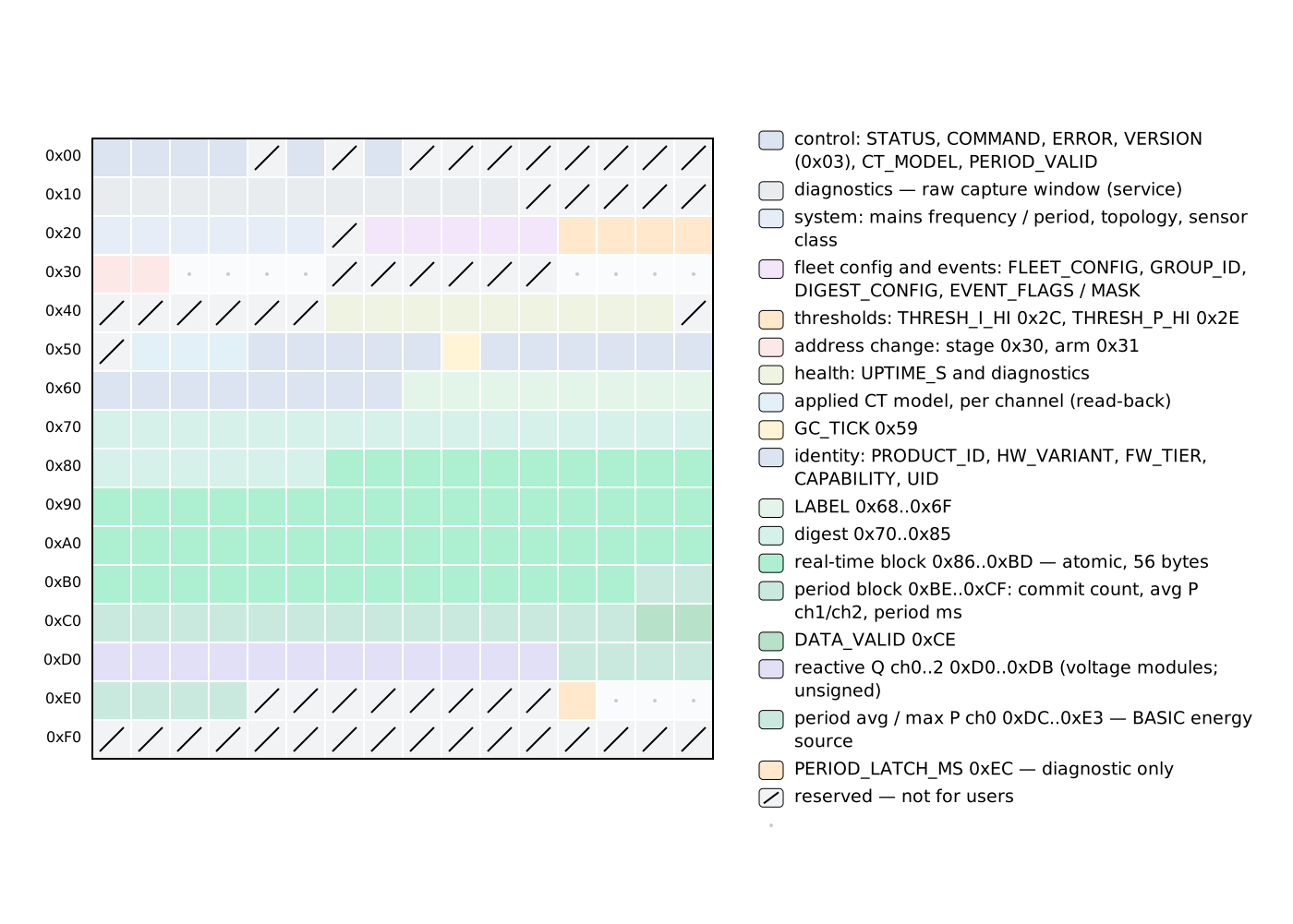
The public API of the RbAmp library for Arduino as of v1.6.1. One class
serves both module product lines — BASIC and STANDARD (STD):
begin() detects the line and every call routes internally. Calls that
only exist on one line are marked; a call with no counterpart on the
detected line fails with RB_ERR_NOT_IMPLEMENTED. Source of truth — the
header files src/RbAmp.h,
src/RbAmpSnapshot.h,
src/RbAmpEnergy.h,
src/RbAmpSensorModels.h,
src/RbAmpRegisters.h (the last
two are auto-generated and must not be edited by hand).
This chapter is a reference: signatures, return values, side effects, edge cases. For working examples see 06 · Examples; for the quick start see 05 · Quickstart.
Header files
| Include | What it brings in |
|---|---|
<RbAmp.h> |
All public types (pulls in the rest) |
<RbAmpSnapshot.h> |
RbAmpSnapshot, RbAmpPeriodSnapshot, RbAmpTopology, RbAmpVariant, RbAmpLine, RbAmpSensorClass, RbAmpSctRating, RbAmpDrdyEvent and the RbAmpStd* structures of the STD line |
<RbAmpEnergy.h> |
RbAmpEnergy |
<RbAmpSensorModels.h> |
Generated sensor-model registry — the RBAMP_CT_* model codes and rbamp_sensor_model_lookup() |
<RbAmpRegisters.h> |
Auto-generated protocol constants — RB_OK, RB_ERR_*, SETTLE_MS_* |
A user sketch normally only needs #include <RbAmp.h> — the rest
are pulled in transitively.
Which line does a call work on?
| Group | BASIC | STD |
|---|---|---|
Lifecycle, real-time reads (readVoltage … readAll), period metering, energy() |
yes | yes |
readReactivePower(), readApparentPower() |
no (RB_ERR_NOT_IMPLEMENTED) |
yes |
Sensor class / CT model setters, saveUserConfig(), address change, reset() |
yes | yes (CT model is a label on STD, see below) |
factoryReset(), General-Call helpers, label helpers, readCapability(), readCommitSeq(), readPeriodLatchMs() |
yes | no (RB_ERR_NOT_IMPLEMENTED) |
Data-ready line and events (setDrdyPin(), waitDataReady(), setEventMask() …) |
yes | yes (module image dependent, see below) |
std* calls (STD line API) |
no (RB_ERR_NOT_IMPLEMENTED) |
yes |
SCT-013 rating correction (sctRating*()) |
yes (SCT-013 class, older BASIC firmware) | never applied (scale 1) |
Some STD features depend on the module image version: micro-energy
counters, the starting current for energy, voltage phase angles and the phase
sequence need an image of at least 0x0001007B
(stdReadImageVersion()). On an older image the library reports them as
"not available" (a valid flag that is false, a derived value, or
RB_ERR_NOT_IMPLEMENTED) — never as a wrong number.
RbAmp class
The main client. One instance per slave device on the I²C bus.
Multiple instances can share a single TwoWire bus to poll several
modules.
Constructor
explicit RbAmp(TwoWire& bus,
               uint8_t addr = 0x50,
RbAmpTopology hint = RbAmpTopology::Single) noexcept;| Parameter | Description |
|---|---|
bus |
Reference to the TwoWire bus (usually Wire). The caller must call bus.begin() BEFORE begin(). |
addr |
7-bit slave address. Range 0x08..0x77, default 0x50. |
hint |
Topology hint: the number of current channels (1/2/3). On pre-v1.3 firmware begin() cannot reliably determine the variant, so the hint is used as a fallback for multi-channel SKUs. Defaults to Single — the safe default, which does not trigger spurious reads of absent channels. For multi-channel modules on pre-v1.3 firmware, pass the matching hint explicitly. |
The constructor generates no I²C traffic.
Lifecycle methods
bool begin() noexcept
Native protocol: 02 · Initialization and Start-up (initialization) · BASIC or STD? (initialization) · Continuous polling cycle (recommended) (period-metering)
Probe the device, detect its product line and variant, prime the snapshot.
Sequence:
- STD identity probe first. If the module answers as an STD module, the
channel counts come from the module itself, snapshot bank 0 is armed and
primed, and
begin()returns — the BASIC steps below are skipped. - Read
REG_VERSION(0x03). If the device did not ACK —falsewithRB_ERR_NACK. If it returned0x00/0xFF—falsewithRB_ERR_VERSION. - Cache the topology: the module's variant byte on firmware that exposes it,
otherwise the constructor
hint. After this,topology()/channels()return valid values without touching the bus. The channel count never exceedsRBAMP_MAX_CHANNELS(7); channels beyond that are not exposed and addressing them returnsRB_ERR_PARAM. - Read
U_rmsto determine whether a voltage sensor is present (threshold 1.0 V). - Write
CMD_LATCH_PERIODas a primer + wait 50 ms. The first snapshot after power-on is discarded (it is not handed to user code — it mixes in pre-power-on data). - Store
millis()for subsequent energy integration. - On a BASIC module with the SCT-013 class, read the per-channel rating
correction (see SCT-013 rating correction).
If the module is in the state that needs a restart to apply the right
gain,
begin()restarts it once.
Idempotent: safe to call again.
Returns: true on success; false otherwise — see
lastError() for details.
bool probe() noexcept
A lightweight liveness check. A single read of REG_VERSION with no
side effects.
Returns: true if the slave ACKed and reported a supported
version (neither 0 nor 0xFF).
bool waitReady(uint32_t timeout_ms = 1000) noexcept
Native protocol: 02 · Initialization and Start-up (initialization) · 3.
DATA_VALID(0xCE) never becomes 1 (troubleshooting) · 4 · Register map (production v1.3) (api-reference)
Polls the module's ready flag until bit 0 is set. Useful after power-on — the module may need up to one measurement window (100 ms) to commit its first data.
Returns: true if the bit was seen before timeout_ms elapsed;
false with RB_ERR_TIMEOUT otherwise.
uint8_t firmwareVersion() noexcept
Returns: the REG_VERSION (0x03) byte. Known BASIC values:
0x01 = v1.0, 0x02 = v1.1, 0x03 = v1.2, 0x04 = v1.3. Later BASIC
firmware reports higher values. 0 or 0xFF indicate an I²C error
(see lastError()).
RbAmpLine line() const noexcept
Native protocol: BASIC or STD? (initialization)
Returns: the product line detected by begin() — RbAmpLine::Basic
(the value until begin() has run) or RbAmpLine::Std. No bus access.
RbAmpTopology topology() const noexcept
Returns: the cached topology. No bus access.
uint8_t channels() const noexcept
Native protocol: Multi-channel current (UI2 / UI3 / UI5 / UI7) (realtime-polling) · 4.10 V03 real-time block (0x86..0xBD) (api-reference) · 4.14 Channel access window (
0x32+0x3C..0x3F) (api-reference)
Returns: the number of current channels, 1..RBAMP_MAX_CHANNELS (7).
On the STD line the count is what the module reports, capped at
RBAMP_MAX_CHANNELS.
bool hasVoltageHw() const noexcept
Native protocol: 3.2
CAPABILITY(regs0x57/0x58, u16 LE, read-only) (api-reference)
Returns: true if a voltage sensor was detected at begin().
Cached, no traffic.
uint8_t address() const noexcept
Returns: the current 7-bit I²C address. Updated after a
successful commitAddressChange().
uint8_t rawTopology() noexcept
A direct read of REG_TOPOLOGY (0x24). Unlike topology(), this
performs an I²C transaction.
Returns:
1/2/3—SINGLE/SPLIT_PHASE/THREE_PHASE.0xFF— I²C error.
For full SKU detection use
readVariant()(readsREG_HW_VARIANT 0x55) — see Identification and provisioning.
Real-time reads (RT block, 100 ms refresh)
All methods return float. On error they return NAN and set
lastError(). Under the hood a retry + sanity filter is used for
robustness against rare link glitches on ESP-IDF (see the diagnostic
counters below). The module publishes new values once per measurement
window — 100 ms (BASIC firmware before v1.2 and STD images up to 0x7B:
200 ms).
float readVoltage(uint8_t phase = 0) noexcept
Instantaneous RMS voltage. phase is 0 on the BASIC line; on the STD line
it is 0 .. n_voltage-1 (see stdInfo()). An out-of-range phase returns
NAN with RB_ERR_PARAM.
float readVoltagePeak(uint8_t phase = 0) noexcept
Peak voltage over the RT window. Same phase rule.
float readCurrent(uint8_t ch = 0) noexcept
Native protocol: Multi-channel current (UI2 / UI3 / UI5 / UI7) (realtime-polling) · 4.14 Channel access window (
0x32+0x3C..0x3F) (api-reference)
Instantaneous RMS current on a channel. ch must be < channels()
— otherwise NAN with RB_ERR_PARAM. This includes any channel at or
beyond RBAMP_MAX_CHANNELS (7).
float readCurrentPeak(uint8_t ch = 0) noexcept
Peak current on a channel over the RT window.
float readPower(uint8_t ch = 0) noexcept
Native protocol: RT register reference (realtime-polling) · Bidirectional accounting (period-metering)
Instantaneous active power on a channel. Signed — a negative value means export (the load feeds power back into the grid, relevant for PV / bidirectional installations).
float readPowerFactor(uint8_t ch = 0) noexcept
Power factor on a channel. Dimensionless, range −1..+1.
float readReactivePower(uint8_t ch = 0) noexcept — STD only
Reactive power on a channel, in var, signed. On BASIC, reactive power is not
exposed by this library: the call returns NAN with RB_ERR_NOT_IMPLEMENTED.
float readApparentPower(uint8_t ch = 0) noexcept — STD only
Apparent power on a channel, in VA. On a BASIC module returns NAN with
RB_ERR_NOT_IMPLEMENTED.
float readFrequency() noexcept
Grid frequency, in Hz.
bool readAll(RbAmpSnapshot& out) noexcept
Native protocol: RT register reference (realtime-polling) · Polling — single module (realtime-polling) · 4.10 V03 real-time block (0x86..0xBD) (api-reference)
The complete RT block in a single call, into a RbAmpSnapshot
struct. Equivalent to sequential readVoltage() + readVoltagePeak()
+ readCurrent(0..N) + readCurrentPeak(0..N) + readPower(0..N) +
readPowerFactor(0..N) + readFrequency(). Unused channels (beyond
channels()) are filled with zeros.
A single field that is read but fails the physical sanity filter is set to
NAN and flagged in out.implausible (RBAMP_FIELD_* bits); the rest of
the snapshot stays usable.
Returns: true unless a transport read failed — then false and
lastError() holds the code of the first error.
Period metering
See 01 · Overview for the big picture and 05 · Quickstart Step 5 for a minimal template.
bool latchPeriod() noexcept
Native protocol: 04 · Period Metering and Tariff Accounting (period-metering)
Writes CMD_LATCH_PERIOD (0x27) to REG_COMMAND. Does not wait —
the caller itself must observe the 50 ms settle and check
isPeriodValid() before reading.
For most tasks use readPeriodSnapshot() — it encapsulates the
entire sequence.
Returns: true on a successful write.
bool isPeriodValid() noexcept
Native protocol: 04 · Period Metering and Tariff Accounting (period-metering) · Calibration and accuracy (troubleshooting) · 7.5 Failed-snapshot period preservation (api-reference)
Reads the snapshot ready bit. true if the last snapshot is fresh and
ready to read.
float readPeriodAvgPower(uint8_t ch = 0) noexcept
Native protocol: Period snapshot registers (period-metering) · 4.11 V03 period block (0xBE..0xCF) (api-reference) · 4.12 V03 Q + period ch0 (0xD0..0xE3, production build) (api-reference)
Average active power on a channel over the closed period. Must be
called after latchPeriod() + 50 ms settle + valid check.
float readPeriodMaxPower() noexcept
Native protocol: Period snapshot registers (period-metering) · 4.12 V03 Q + period ch0 (0xD0..0xE3, production build) (api-reference)
Peak instantaneous power on channel 0 over the closed period.
uint32_t readPeriodLatchMs() noexcept
Native protocol: 13. Multi-module clock drift in long tests (troubleshooting) · 4.13 Diagnostic chip-side dt (0xEC) (api-reference)
Period duration from the device's point of view, in ms.
Diagnostic value.
latch_msis a module diagnostic timer; do not use it for energy — use the master clock (master_dt_msfromRbAmpPeriodSnapshot).
bool readPeriodSnapshot(RbAmpPeriodSnapshot& out, uint16_t settle_ms = 50, bool skip_latch = false) noexcept
Native protocol: Continuous polling cycle (recommended) (period-metering) · Multi-module — simultaneous snapshot (period-metering) · Calibration and accuracy (troubleshooting)
The recommended entry point for period metering. The full sequence under the hood:
- If
skip_latch == true— skip the snapshot command write (applies afterbroadcastLatch()or a manual series of snapshot commands). - Otherwise — write
CMD_LATCH_PERIOD. - Capture
millis()to computemaster_dt_ms. delay(settle_ms)— 50 ms by default per the protocol specification.- Check the snapshot ready flag. If 0 — set
RB_ERR_STALEand record the timestamp (so the next snapshot does not double-count bydt). - Read
avg_p[0..channels-1]+max_p+latch_ms. - Update the timestamp + call
energy().tick(out, channels_)for automatic Wh integration.
| Parameter | Description |
|---|---|
out |
Output struct. |
settle_ms |
Wait after the snapshot command, 50 by default. |
skip_latch |
If true — do not send the snapshot command, only read (for a synchronized multi-board scene). |
Returns: true if out.valid == true; false if the read
failed or the snapshot is stale.
On the STD line the settle after a snapshot is raised to at least 300 ms (the
module services the snapshot at its next measurement-window boundary), latch_ms
is 0 and master_dt_ms is the period. On an STD module that keeps persisted
life-time counters instead of snapshot banks, the period is the difference of two
counter readings on the master's schedule; avg_p_total, wh_net and
module_restarted of the snapshot are filled there.
Energy metering (master-side accumulator)
RbAmpEnergy& energy() noexcept
const RbAmpEnergy& energy() const noexcept
Access to the per-channel Wh accumulator owned by this RbAmp
instance. The accumulator is updated automatically on every
successful readPeriodSnapshot(). For details see the "RbAmpEnergy
class" section below.
double energyWh(uint8_t ch = 0) const noexcept
Native protocol: Master-side algorithm (period-metering) · 7 · Semantics (api-reference)
The running energy total of a channel, like energy().wh(ch) — except on
an STD module that keeps persisted counters but publishes no per-channel split
(more than one channel, older register map): a per-channel request returns
NaN there instead of a 0 that would read as "nothing consumed". Use
RBAMP_ENERGY_CH_TOTAL as ch for the all-channel total.
Sensor configuration
A two-step sequence: first the sensor class, then the model. Both steps are mandatory on BASIC firmware v1.2 and later.
For a detailed model-selection guide see 03 · Current sensor selection.
CT model — a functional preset on BASIC, a label on STD. On a BASIC module, writing the CT model immediately applies the matching preset — the current readings change. Changing the
RbAmpSensorClassresets the channels' CT models to 0 on the module. On an STD module the model is a reference (sensor label) only: it sets no gain, because the module is calibrated per channel.Read-before-write. The setters read the module first. Writing a class or model the module already holds is a no-op (
true, no bus write, no flash cycle), so a stored configuration can be re-applied on every boot without touching the module's calibration. A module of classWiredCTorBuiltinCT(shipped and calibrated together with its sensor) is not reconfigured: the setter returnsfalsewithRB_ERR_MODEand writes nothing.setCTModelChForce()is the service path.Setting a CT model restarts the module. On BASIC firmware up to 1.4.19 with the SCT-013 class,
setCTModel()(both forms) andconfigureChannels()restart the module after the save so that the new model takes effect (about a second in total, blocking), then re-read the rating correction. Do not call them in a loop and do not expect readings during that time.
bool setSensorClass(RbAmpSensorClass cls) noexcept
Native protocol: Setting the sensor class and CT model (initialization) · 4.3 System (0x20..0x25) (api-reference) · 6.2 CT model binding — pure staging + per-channel CMD (api-reference)
Set the current sensor class with a save to flash.
Sequence: read the module's current class (read-before-write) → write
REG_SENSOR_CLASS (0x25) → CMD_SAVE_USER_CONFIG (0x32) → wait 700 ms
(flash erase). Blocking. Production-OK — SAVE_USER_CONFIG is not gated.
Must be called before setCTModel(). Otherwise setCTModel()
returns false with RB_ERR_PARAM. It also resets the CT models
to 0 on the device side, so set the models afterwards. On the STD line the
class is metadata, persisted with the module's config save, and the same
read-before-write rules apply.
| Argument | Meaning |
|---|---|
RbAmpSensorClass::Sct013 |
SCT-013 series clamp fitted by the user; the model selects the sensor type |
RbAmpSensorClass::WiredCT |
wired CT shipped with the module and calibrated together with it — not rewritten by the setters |
RbAmpSensorClass::BuiltinCT |
built-in CT, calibrated together with the module — not rewritten by the setters |
Returns: true on success, or when the module already holds cls.
false with RB_ERR_MODE when the module is of class WiredCT /
BuiltinCT.
bool readSensorClass(uint8_t& out) noexcept
Native protocol: 4.3 System (0x20..0x25) (api-reference)
Reads the module's current sensor class (an RbAmpSensorClass value;
0 = unset). Works on both lines.
Returns: true on success.
bool setCTModel(uint8_t code) noexcept
The single-parameter form — sets the CT clamp model on channel 0
only. Convenient for single-channel SKUs (UI1/I1); on multi-channel
ones it is equivalent to setCTModel(0, code).
Sequence: write REG_CT_MODEL (0x05) → CMD_SET_CT_MODEL_CH0 (opcode 0x28) → 5 ms settle → CMD_SAVE_USER_CONFIG (opcode 0x32) → 700 ms. Production-OK — uses the user-config save path, no factory-mode gating.
Name the model with the generated RBAMP_CT_* define (from
RbAmpSensorModels.h), for example RBAMP_CT_SCT013_030:
| Define | code |
Model |
|---|---|---|
RBAMP_CT_SCT013_005 |
1 | SCT-013-005 |
RBAMP_CT_SCT013_010 |
2 | SCT-013-010 |
RBAMP_CT_SCT013_030 |
3 | SCT-013-030 |
RBAMP_CT_SCT013_050 |
4 | SCT-013-050 |
RBAMP_CT_SCT013_100 |
5 | SCT-013-100 |
RBAMP_CT_SCT013_020 |
6 | SCT-013-020 |
RBAMP_CT_SCT013_060 |
7 | SCT-013-060 |
A code that is not in the registry for the module's class → false with
RB_ERR_PARAM and no write. A code that is in the registry but that the
module does not accept is rejected by the module with RB_ERR_PARAM; the
channel keeps its previous model. For the full per-class accept-set see
03 · Current sensor selection.
For multi-channel modules use the per-channel form below.
bool setCTModel(RbAmpCTModel model) noexcept
Typed-enum overload for the seven SCT-013 codes (RbAmpCTModel::Sct013_030
…). Equivalent to setCTModel(static_cast<uint8_t>(model)). Kept for
backward compatibility; new code passes a generated RBAMP_CT_* define to the
uint8_t form, which is the only way to name a wired-CT model.
bool setCTModel(uint8_t channel, uint8_t code) noexcept
Native protocol: Setting the sensor class and CT model (initialization) · 6.2 CT model binding — pure staging + per-channel CMD (api-reference)
The per-channel form. Sets the CT clamp model on a specific channel,
0 .. channels()-1 (channels 3 and up are the senior-SKU channels; they need
BASIC firmware v1.4.18 or later).
Under the hood: write REG_CT_MODEL (0x05) → command CMD_SET_CT_MODEL_CH0/1/2
(opcode 0x28/0x29/0x2A) according to channel → 5 ms settle → CMD_SAVE_USER_CONFIG
(opcode 0x32) → 700 ms. Production-OK — the user-config save path is the
production persistence channel for ct_model / sensor_class / per-channel CT.
Channels 3 and up are bound through the channel window and read back; a model
the module rejects is reported as RB_ERR_PARAM. On firmware older than
v1.2 the call returns RB_ERR_VERSION.
Call order is arbitrary on v1.3. Writing
REG_CT_MODEL (0x05)only stages a value — it is not auto- applied to channel 0. Application happens exclusively through the per-channel opcodeCMD_SET_CT_MODEL_CHn(0x28 / 0x29 / 0x2A), which copies the staged value into its own channel. Channels can therefore be configured in any order — ascending, descending, or interleaved — without clobber:
cpp
dev.setCTModel(0, RBAMP_CT_SCT013_005);   // channel 0
dev.setCTModel(1, RBAMP_CT_SCT013_030);   // channel 1
dev.setCTModel(2, RBAMP_CT_SCT013_020);   // channel 2
After a multi-channel bind, confirm the result with
readCTModelCh(). For a batched, one-save configuration of all channels preferconfigureChannels().
RB_ERR_PARAM guard on the setSensorClass() precondition, same as
in the single-parameter form. A channel at or beyond channels() (and so
any channel beyond RBAMP_MAX_CHANNELS) → RB_ERR_PARAM. Read-before-write
and the RB_ERR_MODE refusal apply as described above. On the STD line the
model is a label written to the per-channel entry, read back and persisted
with the module's config save; no channel-0 side effect.
Returns: true on success, or when the channel already holds code.
bool setCTModel(uint8_t channel, RbAmpCTModel model) noexcept
Typed-enum overload of the per-channel form (SCT-013 codes only).
bool setCTModelChForce(uint8_t channel, uint8_t code) noexcept
Service path. Same as setCTModel(channel, code) but writes regardless of
the module's class and of the model the channel currently holds. It replaces
the paired calibration of that channel with the model's generic preset — use
it only when re-pairing a module with a new sensor in service, and follow it
with a calibration. A code absent from the registry is still rejected
(RB_ERR_PARAM, no write).
Returns: true on success.
bool readCTModelCh(uint8_t channel, uint8_t& out) noexcept
Native protocol: 4.7 CT model verify mirrors (0x51..0x53) (api-reference) · 8.10 CT model verify-mirror read-back (post-binding sanity) (api-reference)
Reads the CT model actually applied to a channel (the verify mirror of the
bound preset). Use it to confirm that a bind took. out = 0 means unset.
Returns: true on success.
Sensor registry — sensorModel() / sensorModelRatedA()
Pure lookups in the generated registry (RbAmpSensorModels.h). No bus
traffic. A registry hit does not mean the connected module accepts the code
— that is decided by the module at write time.
static const rbamp_sensor_model_info_t* RbAmp::sensorModel(uint8_t cls, uint8_t code) noexcept;
static const rbamp_sensor_model_info_t* RbAmp::sensorModel(RbAmpSensorClass cls, uint8_t code) noexcept;
static float RbAmp::sensorModelRatedA(uint8_t cls, uint8_t code) noexcept;
static float RbAmp::sensorModelRatedA(RbAmpSensorClass cls, uint8_t code) noexcept;
sensorModel() returns the registry entry or nullptr if (class, code) is
not in the registry. The entry (rbamp_sensor_model_info_t) carries
sensor_class, code, name, descriptor, status (characterized /
reserved / legacy) and the current limits nominal_a (rated RMS current),
fs_a (RMS current at the onset of clipping for a sine) and peak_a
(instantaneous clipping ceiling). 0 in a limit = not known for that model.
sensorModelRatedA() returns the rated RMS current in amperes (0 = not
known). It covers the SCT-013 family and the clamp models that carry a
rating; legacy toroid / burden codes return 0.
float rated = RbAmp::sensorModelRatedA(RbAmpSensorClass::Sct013, RBAMP_CT_SCT013_030);
const rbamp_sensor_model_info_t* m = RbAmp::sensorModel(RbAmpSensorClass::Sct013, RBAMP_CT_SCT013_030);
if (m) Serial.println(m->descriptor);
SCT-013 rating correction
On BASIC firmware up to 1.4.19 a module with the SCT-013 class is calibrated
on the SCT-013-030 and, after a restart, applies that calibrated gain
whatever model a channel shows. The library compensates: begin() reads each
channel's model and applied gain and sets a per-channel scale. The
scale is applied to readCurrent(), readCurrentPeak(), readPower(),
readAll(), readPeriodAvgPower(), readPeriodMaxPower() and
readPeriodSnapshot() — and therefore to the energy derived from them.
Power factor and voltage are not touched. Plausibility bounds and
setEventThresholds() are expressed in true amperes / watts.
So changing the SCT-013 rating (for example from 030 to 050) auto-corrects current, power and energy; it does not change U or PF. Firmware 1.4.20 and later corrects itself — the scale stays 1 and a model write needs no restart. STD modules and the wired / built-in CT classes are never scaled.
bool sctRatingRefresh() noexcept
Re-reads each channel's rating state from the module. The library already
does this after readEventFlags() reports EVENT_RESET_OCCURRED; call it
yourself after a module restart you detect some other way.
Returns: true when the module could be read.
bool sctRating(uint8_t channel, RbAmpSctRating& out) noexcept
State of one channel: model, applied_gain, noise_floor, scale and
status.
Returns: true if channel is valid.
RbAmpSctRatingStatus |
Meaning |
|---|---|
NotApplicable |
STD line, a class other than SCT-013, firmware that corrects itself, or no model set — scale 1 |
Native |
the channel shows the model the module was calibrated on (030) — nothing to correct, scale 1 |
Corrected |
another SCT-013 model on older BASIC firmware — readings are scaled |
Uncalibrated |
the module applies a generic preset without its own trim — nominal correction only |
UnexpectedGain |
the applied gain is not what the correction expects — nothing is assumed, scale 1 |
Unknown |
the state could not be read — scale 1 |
float sctRatingScale(uint8_t channel) const noexcept
The factor applied to that channel's current / power readings (1.0 when
nothing is corrected, and for a channel index beyond RBAMP_MAX_CHANNELS).
static float sctPresetGain(uint8_t model) noexcept
The library's preset gain figure for an SCT-013 model code; 0 if unknown.
Mostly useful for diagnostics.
bool configureChannels(RbAmpSensorClass cls, const uint8_t* models, uint8_t n) noexcept
See Multi-channel configuration.
bool saveGains() noexcept — factory-mode only on BASIC
A "bare" CMD_SAVE_GAINS (0x26) write — the factory persistence
path for calibration coefficients (gains / noise floor / phase).
⚠ Factory-only on BASIC. BLOCKED in production. On a production BASIC module
CMD_SAVE_GAINSis rejected by the firmware — the call returnsfalse,REG_ERRORis set toDEV_ERR_PARAM(0xFE), and the next reboot reverts any RAM-only writes. For all user-facing persistence (sensor class, CT model per channel, address, fleet config, label) usesaveUserConfig()(CMD_SAVE_USER_CONFIG, opcode 0x32) — that is the production-OK persistence path. User code in a deployment context should not callsaveGains().
STD line: saveGains() issues the module's calibration save, waits until
the module reports the command finished and checks its verdict. The module
writes its store at most once per 5 s; a save inside that window is retried
once after 5 s.
Returns: true on a successful command (BASIC production: always
false with RB_ERR_MODE).
bool prepareAddressChange(uint8_t new_addr) noexcept
Native protocol: Address change (initialization) · 4.5 Address (0x30..0x31) (api-reference) · 6.1 Address change — two-phase commit (production-OK) (api-reference)
Step 1 of 2 for changing the module's I²C address. Production-OK on the current firmware (v1.3 two-phase commit, no factory-mode gating for the address).
Sequence: validate the new_addr range (0x08..0x77, ≠ current) → write the candidate to REG_I2C_ADDRESS (0x30) in RAM → write magic 0xA5 to REG_ADDR_COMMIT_MAGIC (0x31) — armed. The caller must call commitAddressChange() within 5 seconds, otherwise the arming expires.
Returns: true if armed successfully.
bool commitAddressChange() noexcept
Native protocol: Address change (initialization) · 6.1 Address change — two-phase commit (production-OK) (api-reference) · 8.5 Address change 5-step (api-reference)
Step 2 of 2. Must be called within 5 seconds of prepareAddressChange().
Sequence: check the freshness of the magic-armed state → CMD_COMMIT_ADDR (opcode 0x30) → persist to flash → CMD_RESET (0x01) → ~300 ms boot-to-responsive → update the internal address field. After this, all calls on this instance address the new address.
⚠ Re-enumeration after commit. After a successful commit the device resets and re-enumerates at the NEW address. Subsequent calls on this
RbAmpinstance address the new address transparently — but any OTHER master on the bus (a Python script, an ESP-IDF component on another MCU, a debug probe) will keep thinking the device is at the old address until its internal state is updated by hand.⚠ Verification path (v1.3): after reboot
REG_I2C_ADDRESS (0x30)reads the active address. A bus scan at the new address also works to confirm the commit.The address change is a production operation (not factory-only). The I²C address — the documented path is reconfiguration via the factory bench (outside the library's scope).
An additional note for commitAddressChange():
⚠ Restart and re-enumeration after commit. After a successful commit the device resets and re-enumerates at the NEW address. Subsequent calls on this
RbAmpinstance address the new address transparently — but any OTHER master on the bus (a Python script, an ESP-IDF component, a debug probe) will keep thinking the device is at the old address until its internal state is updated by hand.
If the arming window has expired, commitAddressChange() returns
false with RB_ERR_TIMEOUT and clears the arming flag — a fresh
prepareAddressChange() will be required.
Returns: true on success.
STD line: the address field is written and saved (the call waits for the
save to finish; a rejected address returns RB_ERR_PARAM and the module keeps
its address), then the module is reset. The instance switches to the new
address only once the module answers there (up to 3 s). If it comes back on
the OLD address instead, the instance stays there and RB_ERR_NOT_READY is
returned.
bool factoryReset() noexcept
The CMD_FACTORY_RESET command (0xAA) + wait 1500 ms.
⚠ Destructive operation. Erases ALL flash parameters (CT model, sensor class, calibration coefficients, I²C address). The module returns to its factory defaults —
RbAmpSensorClassbecomesUnset,REG_CT_MODELbecomes 0. Any setting previously applied viasetSensorClass()/setCTModel()is gone. The next user MUST re-apply bothsetSensorClass()andsetCTModel()before metering works again. This is not a "soft restart" — for a soft restart usereset().factoryReset()is reserved for recovery from a known-bad state or for handing the module off to another user / another installation.
Returns: true on a successful command write.
STD line: there is no counterpart — the call returns false with
RB_ERR_NOT_IMPLEMENTED.
bool reset() noexcept
The CMD_RESET command (0x01) + wait 100 ms. A soft restart of the
device without losing flash parameters.
Returns: true on a successful command write.
STD line: waits for any running command first (a module is never reset mid-save), then waits quietly (up to 3 s) for the module to answer again and re-arms the period path.
Multi-module bus (static)
static bool broadcastLatch(TwoWire& bus) noexcept
Sends an I²C General-Call broadcast snapshot (A5 27 00 tick_lo tick_hi
to address 0x00) — all modules with GC enabled take the period snapshot
simultaneously. On v1.3 firmware GC is supported as an opt-in
capability: per-module enable via REG_FLEET_CONFIG.bit0 (cleared by
default); the module's capability map says whether it supports the
General-Call snapshot. General-Call is a BASIC-line feature (the General-Call
and label helpers return RB_ERR_NOT_IMPLEMENTED on an STD instance).
Return semantics:
- v1.3 firmware, GC enabled on at least one module — returns
true, the fleet takes its snapshot in sync (skew < 1 ms across modules). - v1.3 firmware, GC disabled on all modules —
Wire.endTransmission()to0x00NACKs at the bus level → returnsfalse. Fix: enable GC per module viaenableGc(true)(writesFLEET_CONFIG.bit0+SAVE_USER_CONFIG+ reset), or useRbAmpFleet::enableGcAll(). - Legacy firmware without General-Call support —
returns
falsewithout touching the bus. Fall back to a sequential series oflatchPeriod()on each device — see 06 · Examples, the multi-module bus section.
Diagnostics
int8_t lastError() const noexcept
Returns: the code of the last error — RB_OK (0) or one of the
RB_ERR_* values (negative). The full table is in the "Error codes"
section below + 10 · Troubleshooting.
static const char* errorString(int8_t code) noexcept
Returns: a constant string with a human-readable description of
the error code. Never returns NULL.
void setLogStream(Stream* stream) noexcept
An optional diagnostics sink. If set, the library briefly logs the
results of probe(), stale snapshots, and mode rejections. Pass
nullptr to turn it off. Off by default.
Typical use:
dev.setLogStream(&Serial);uint32_t retryExhaustionCount() const noexcept
Native protocol: 05 · Troubleshooting (troubleshooting)
How many times since power-on (or the last resetCounters()) the
retry loop was exhausted during a single-byte read. The steady-state
value is 0. A non-zero value is a sign of link problems (see
10 · Troubleshooting).
uint32_t sanityRejectCount() const noexcept
Native protocol: 05 · Troubleshooting (troubleshooting)
How many raw float values were rejected by the sanity filter
(!isfinite(x) || |x| > 10000). Steady-state — 0. A non-zero
value after retry mitigation usually means a rare ESP-IDF I²C-stack
artifact that survived the retry layer.
void resetCounters() noexcept
Zero both counters. Use it at the start of a soak test or a regression window to measure only the events within the window.
const char* errorString() const noexcept
Instance shortcut for errorString(lastError()). Never returns NULL.
bool readCommitSeq(uint8_t& out) noexcept — BASIC only
Reads the module's commit sequence byte. The module increments it once per
published measurement window (100 ms on firmware v1.2+, 200 ms before),
wrapping 255→0. Sample it before and after a multi-register read to detect
that the published values advanced mid-read. It is a change flag only — there
is no CRC. On an STD instance the call fails with RB_ERR_NOT_IMPLEMENTED
(use readDataSeq()).
Returns: true on success.
Identification and provisioning (v1.3)
These methods let the master understand exactly what is connected to the bus (variant, capability bit-map, UID, label) and prepare a new or freshly flashed module for operation (provisioning + saving the configuration to flash).
RbAmpVariant readVariant() noexcept
Native protocol: Module variant auto-detection (initialization) · rbAmp Wire-Protocol Reference (v1.3) (api-reference) · 3.6 Canonical detection algorithm (api-reference)
Reads the module's HW_VARIANT (0x55) register and returns an
RbAmpVariant:
| Value | SKU | I channels | U channel |
|---|---|---|---|
UI1 (1) |
UI1 | 1 | yes |
UI2 (2) |
UI2 | 2 | yes |
UI3 (3) |
UI3 | 3 | yes |
I1 (4) |
I1 | 1 | no |
I2 (5) |
I2 | 2 | no |
I3 (6) |
I3 | 3 | no |
UI5 (7) |
UI5 (senior SKU) | 5 | yes |
UI7 (8) |
UI7 (senior SKU) | 7 | yes |
Unknown (0) |
not identified (firmware v1.0/v1.1, an I²C failure, or not an rbAmp) | — | — |
Variant autodetect via
readVariant()is the recommended path. The constructor topology hint remains as a fallback for pre-v1.2 firmware (whereHW_VARIANTis not available). Default hint =RbAmpTopology::Single— safe, it does not trigger spurious reads of absent channels on UI1/I1.
bool readCapability(uint16_t& out) noexcept — BASIC only
Native protocol: Module variant auto-detection (initialization) · 3.2
CAPABILITY(regs0x57/0x58, u16 LE, read-only) (api-reference) · 8 · Wire-trace examples (api-reference)
Reads the module's 16-bit feature map. Branch on the named capability
constants of RbAmpRegistersV2.h (namespace rbamp::v2), never on
firmware-version heuristics. Among other things the map says whether the
module has a voltage front-end — if not, it does not compute P / PF / energy
and those values read 0 — and whether it supports the General-Call
broadcast snapshot (see broadcastLatch()). On an STD instance the call returns
false with RB_ERR_NOT_IMPLEMENTED; use stdInfo() there.
uint8_t readProductId() noexcept
Native protocol: 3.5
PRODUCT_ID(0x54, u8, read-only) (api-reference) · 4.8 Identity (0x54..0x6F) (api-reference)
Reads PRODUCT_ID (0x54) — the byte identifier of the family
(rbAmp sensor = 0x01, rbDimmer = 0x02; 0 on failure). Used by the
fleet scanner to confirm that the device at an address really is an rbAmp
and not some other I²C slave that happened to respond at the same address.
An STD instance reports the sensor family.
bool readUid(uint8_t uid[12]) noexcept
Native protocol: 4.8 Identity (0x54..0x6F) (api-reference)
Reads the 96-bit unique MCU identifier from UID (0x5C..0x67) in a
single burst operation. The UID is guaranteed unique for every
module and does not change on re-flash — convenient for serial logs,
master-side anti-clone checks, and identification when a module is
replaced in a deployed fleet. Works on both lines.
bool readLabel(char out[9]) noexcept — BASIC only
Native protocol: 8.3 Multi-byte WRITE —
LABELbyte-at-a-time (api-reference)
Reads the 8-byte user label from LABEL (0x68..0x6F). ASCII,
zero-padded; the result is always null-terminated (a 9-byte array =
8 data bytes + the terminating \0). An empty label = unset.
bool writeLabel(const char* label) noexcept — BASIC only
Native protocol: 8.3 Multi-byte WRITE —
LABELbyte-at-a-time (api-reference)
Writes the 8-byte label. Accepts a null-terminated string — extra
bytes are truncated, missing ones are padded with zeros. The write
is byte-at-a-time for multi-byte writes (the rbAmp wire protocol
auto-increments register reads in burst mode, but not register
writes — see Wire-protocol details below;
the library does the byte loop automatically). After the write you
need dev.saveUserConfig() so the label survives a reset.
A module fresh from the factory can report error
0xFB(DEV_ERR_FLASH_PARAMS_BAD) on its first boot: the user-config block is still empty. This is normal (not fatal);saveUserConfig()clears it. Do not abort provisioning on the first sight of0xFB.
bool saveUserConfig() noexcept
Native protocol: 6.5 Provisioning — fresh-flash + SAVE (api-reference) · 8.6 Fresh-flash provisioning (api-reference)
Issues CMD_SAVE_USER_CONFIG (opcode 0x32) — saves the user-config
block to flash: SENSOR_CLASS, CT_MODEL per channel,
I2C_ADDRESS, FLEET_CONFIG, GROUP_ID, LABEL. It does not
save factory-cal parameters — those are under a separate
CMD_SAVE_GAINS, locked in production mode.
Blocks the thread for ~700 ms (flash erase + write cycle). For the duration of the call, do not try to access the module from other tasks.
STD line: issues the module's config save (class, CT reference, tier,
I²C address; calibration is preserved), waits until the module reports the
command finished (no fixed sleep) and checks its verdict — an invalid field
(for example an out-of-range address) returns RB_ERR_PARAM. A save inside
the module's 5 s store rate limit is retried once after 5 s.
Read-back ≠ persistence: confirming that a value was written to flash requires a reboot + a re-read. See the "v1.3 error model" section below.
v1.3 error model — two independent channels
Errors have two independent channels that work in different ways. Understanding the difference is critical to interpreting the module's state correctly.
| Channel A — client-side, sync | Channel B — DUT-side, durable async | |
|---|---|---|
| Where it lives | Validation inside the library (Arduino lib) | REG_ERROR (0x02) + EVENT_FLAGS.bit3 (0x2A) |
| When it fires | Before the I²C transaction (the lib stops it) | After the FW accepted the write and rejected it |
| What the master sees | the setter returns false + lastError() == RB_ERR_PARAM; REG_ERROR on the device stays 0x00 |
REG_ERROR = the failure code immediately; bit3 latches a few hundred milliseconds after the transaction |
| Sticky | no (just a bool return) | REG_ERROR last-write; bit3 sticky W1C |
| Typical path | An argument outside the allowed bounds (channel ∉ {0,1,2}, code ∉ the characterized set, sensor_class out-of-enum) | A raw register write the library does not pre-validate (low-level use of writeReg() with an invalid mask) |
Channel A — client-side validation (library setters)
All library setters (setSensorClass, setCTModel,
setCTModel(ch, code), configureChannels, etc.) first check the
arguments against the allowed values. If an argument is out of
range, the setter returns false and sets
lastError() == RB_ERR_PARAM, without performing any I²C
transaction at all. Accordingly, REG_ERROR on the device is
not touched:
if (!dev.setCTModel(/*ch=*/99, /*code=*/3)) {       // client-side guard
    Serial.print(F("rejected: "));
    Serial.println(dev.lastError());                 // RB_ERR_PARAM (lib cached)
    uint8_t reg_err = dev.readLastError();           // device REG_ERROR byte
    Serial.println(reg_err, HEX);                    // 0x00 — REG_ERROR untouched
}
lastError()vsreadLastError()— two different channels, not synonyms.lastError()returns the lib-side cachedRB_ERR_*code from the previous call — with no I²C operation.readLastError()does a single wire read of the device'sREG_ERROR (0x02)register — the last-write outcome from the firmware side. In Channel A (above),lastError()=RB_ERR_PARAMwhilereadLastError()=0x00(the lib never reached the wire — REG_ERROR untouched). In Channel B (below) both will show a code, but differently:lastError()— the last cached lib semantics;readLastError()— the exact value of the REG_ERROR byte right now.
This means: if you want to know exactly why a setter refused, the
reliable source is the function's return code + lastError().
REG_ERROR on the device will tell you nothing in this scenario.
Channel B — DUT-side rejection (durable async)
If the write went through I²C (the lib did not stop it because the argument looked valid) but the firmware rejected it, the second channel kicks in:
readLastError()immediately holds the reason code (for example,0xFE = DEV_ERR_PARAM). This is the last-write outcome: any next successful write will overwrite it. You must read it immediately after your write, before any other transaction.hasError(out)— the sticky W1C indicatorEVENT_FLAGS.bit3. It does not latch instantly: on the bench a delay of a few hundred milliseconds delay was measured between the failed transaction and bit3 being set. Right after the write bit3 is stillfalse; after 300 ms it istrue. After that,bit3holds across any number of reads.
⚠ Do not use
hasError()to validate a write you just made. For the outcome of this specific write onlyreadLastError()is reliable, read immediately after the write before any other transaction (plus the setter's return code, if it has one).hasError()is an async channel for polling-style monitoring of "did anything fault between two checks", not for synchronous validation.
Clearing a durable error — clear both (REG_ERROR and bit3)
bit3 is picked up by the firmware every few hundred milliseconds from the
current state of REG_ERROR. So a plain clearEventFlags(1 << 3)
will not work — bit3 will immediately be re-set from the
not-yet-cleared REG_ERROR. The correct order: first clearError()
(clears REG_ERROR), then clearEventFlags(1 << 3) (clears the
sticky latch). If you want atomicity — there must be no rejected
write between them.
uint8_t readLastError() noexcept
Native protocol: 3.
DATA_VALID(0xCE) never becomes 1 (troubleshooting) · Error codes (REG_ERROR=0x02) (troubleshooting) · 4 · Register map (production v1.3) (api-reference)
Reads the device's REG_ERROR (0x02) register directly (a single
wire read; returns 0x00 for OK, 0xFA..0xFF for an error class, and 0xFF
if the I²C read itself failed) — the outcome of the last transaction successfully
accepted by the bus (a write or a command). Not sticky: any next
successful write overwrites it with its own outcome. Used in Channel
B (DUT-side rejection) for the extended reason code. On the STD line
the command verdict is already mapped to lastError() (see the
STD line API).
Not to be confused with
lastError(): that is a different method, which returns the library-cachedRB_ERR_*from the previous lib call with no I²C operation. See the callout in Channel A above.
bool hasError(bool& out) noexcept
Native protocol: 5 · Wire protocol (api-reference)
A convenience helper over EVENT_FLAGS.bit3. Returns true in out
if bit3 is set. Sticky W1C; not cleared until an explicit clear (with
a caveat — see the "Clearing a durable error" section above).
bool readEventFlags(uint8_t& out) noexcept / bool clearEventFlags(uint8_t mask) noexcept
Native protocol: 8.8 Threshold event flow — write threshold → trigger → W1C clear (api-reference)
EVENT_FLAGS (0x2A) — a byte of sticky flags; the specific bits are
described in the specification (including ERROR_OCCURRED bit3).
Clear is write-1-to-clear: write a mask with ones in the bits you
want to reset.
bool clearError() noexcept
Native protocol: Error codes (
REG_ERROR=0x02) (troubleshooting) · 6.7 Error-state recovery — decision tree (api-reference)
Issues CMD_CLEAR_ERROR (opcode 0x31) — zeros REG_ERROR.
Required to clear a durable error paired with
clearEventFlags(1 << 3) (see above). Without clearError(), a
simple clearEventFlags(1 << 3) will leave bit3 true after
a few hundred milliseconds because of re-latch.
Multi-channel configuration (v1.3)
On multi-channel modules each current channel has its own CT sensor model.
The atomic utility for bulk configuration is configureChannels().
bool configureChannels(RbAmpSensorClass cls, const uint8_t* models, uint8_t n) noexcept
Native protocol: 8.6 Fresh-flash provisioning (api-reference)
Parameters:
- cls — the sensor class, applied first. With RbAmpSensorClass::Sct013
the models are bound; a request to bind models under WiredCT /
BuiltinCT is refused up front (false, RB_ERR_MODE, nothing written).
- models — an array of n CT-model codes (generated RBAMP_CT_* defines),
one per channel. 0 leaves that channel's existing model untouched.
- n — the array length. Clamped to channels(): extra array
elements are ignored. If n is smaller — the missing channels are
left untouched (they keep their previous model).
Internally the function performs:
setSensorClass(cls)once.- For each channel
k < min(n, channels): stageREG_CT_MODEL = models[k]+CMD_SET_CT_MODEL_CHk. - One terminal save at the end — one flash erase + write cycle for the whole configuration instead of one per channel (about 3× fewer wear cycles on three channels).
Read-before-write applies: a class or model the module already holds is not rewritten, so re-applying the same configuration costs only reads and no flash cycle. On BASIC firmware up to 1.4.19 with the SCT-013 class, the module is restarted after the save (see Sensor configuration).
Return:
- true — the configuration was applied and saved (or was already in place).
- false + lastError() == RB_ERR_PARAM — an invalid cls or a
models[k] that is not in the registry (client-side validation, see
"Error model" above); the batch is aborted.
- false + RB_ERR_MODE — the module is of a factory-paired class.
- false + other codes — bus error, timeout, etc.
Accepted codes for
SCT_013:{1, 2, 3, 4, 5, 6, 7}(SCT-013-005, -010, -030, -050, -100, -020, -060). Details — 03 · Current sensor selection.
bool readCTModelCh(uint8_t ch, uint8_t& out) noexcept
Reads the applied (verify-mirror) CT sensor model on a specific channel.
This is a read-back from RAM, not a confirmation of persistence —
to confirm a flash save use dev.reset() + a re-read of the mirror.
Data-ready line and events
Both lines. The module's DRDY output is open-drain, idle HIGH (host
pull-up), and pulses LOW each time a new complete snapshot is published —
once per measurement window (100 ms). Several modules may share one line
(wired-OR). A module whose masked event is pending holds the line solid
LOW (alarm level) until the flags are cleared. On the STD line the event
block exists on modules whose image provides it; on BASIC from firmware v1.3.
Hardware details — 04 · Wiring.
bool setDrdyPin(int pin) noexcept
Native protocol: 01 · Hardware Connection (hardware-connection) · 03 · Real-Time Polling (realtime-polling)
Attach the DRDY line of this module (or detach with pin < 0). Configures
the pin as an input with the internal pull-up and a falling-edge interrupt;
the ISR only counts and time-stamps the edge — no bus traffic there. Up to 4
distinct lines and 8 modules per line. An STD module whose image does not
support the data-ready contract refuses with RB_ERR_NOT_IMPLEMENTED;
waitDataReady() then polls the sequence. Without a line waitDataReady()
polls as well.
bool waitDataReady(uint32_t timeout_ms, RbAmpDrdyEvent* ev = nullptr) noexcept
Native protocol: 01 · Hardware Connection (hardware-connection) · 03 · Real-Time Polling (realtime-polling)
Block until this module publishes a new snapshot (or an alarm), at most
timeout_ms (0 = one non-blocking check).
With a line: waits for the edge, then confirms it was this module's by its
snapshot sequence (a pulse from another module on a shared line is ignored).
If the line is still LOW shortly after the edge, some module on it holds an
alarm: the flags of every alarm-capable module on the line are read and
cleared; this module's flags come back in ev, the others' are parked on
their instances and reported by their next wait. Without a line it polls the
sequence every RBAMP_DRDY_POLL_MS (default 20 ms; define it before including
the library to override).
Returns: true with ev filled; false with RB_ERR_TIMEOUT when
nothing arrived, RB_ERR_NOT_IMPLEMENTED on an STD module whose image has no
publish counter.
bool readAllReady(uint32_t timeout_ms, RbAmpSnapshot& out, RbAmpDrdyEvent* ev = nullptr) noexcept
Native protocol: Polling — single module (realtime-polling)
waitDataReady() followed by readAll(), so the whole read lands inside one
publish window: the snapshot is never read twice and never straddles a
publish.
bool readDataSeq(uint16_t& out) noexcept
The module's snapshot sequence — the publish counter on STD, the commit sequence on BASIC. For change detection only.
uint8_t beginEventFlags() const noexcept
The event flags as begin() found them, before the library wrote anything.
EVENT_RESET_OCCURRED there means the module restarted before this instance
met it. No bus access.
bool readEventMask(uint8_t& out) noexcept / bool setEventMask(uint8_t mask) noexcept
Read / set which event bits hold DRDY LOW (rbamp::v2::EVENT_* bits).
setEventMask() verifies by read-back. The mask lives in the module's RAM:
re-apply it after a module reset (EVENT_RESET_OCCURRED tells you).
bool setEventThresholds(float i_amps, float p_watts) noexcept
Native protocol: 4.4 Fleet config (0x27..0x2F) (api-reference) · 8.8 Threshold event flow — write threshold → trigger → W1C clear (api-reference)
Set the current / power thresholds behind EVENT_THRESH_I /
EVENT_THRESH_P; a value <= 0 disables that threshold. RAM on the module.
- BASIC compares the maximum channel current and the signed sum of channel powers — export never trips it.
- STD compares any channel's current and the magnitude of the grand power — direction-agnostic.
Threshold events are level-latched on the module (re-set every window while the condition holds): lift the threshold before expecting a quiet line.
readEventFlags() / clearEventFlags() / hasError() are described under
Error model.
RbAmpDrdyEvent
struct RbAmpDrdyEvent {
    bool     fresh;        // a new snapshot of THIS module is available
    bool     by_edge;      // woken by the DRDY edge (false = found by polling)
    uint16_t seq;          // snapshot sequence now
    uint16_t missed;       // snapshots published since the previous call that were not read
    bool     alarm;        // the line was held LOW (masked event pending on this module)
    uint8_t  event_flags;  // event flags consumed from this module on an alarm, else 0
    uint32_t latency_us;   // edge to return, µs (0 when polling)
};RbAmp dev(Wire, 0x50);
...
dev.setDrdyPin(15); // optional: omit to poll
dev.setEventThresholds(0, 3000); // power threshold, W
dev.setEventMask(rbamp::v2::EVENT_THRESH_P);
RbAmpSnapshot snap;
RbAmpDrdyEvent ev;
if (dev.readAllReady(500, snap, &ev)) {
if (ev.alarm) { /* ev.event_flags holds the cleared flags */ }
// use snap
}Feature overview
The feature summaries below were moved here from the README.
- Current-sensor configuration —
setSensorClass(class)picks the family (SCT-013 fitted by you; wired / built-in CT modules ship calibrated with their sensor and are not reconfigured), thensetCTModel(code)— orconfigureChannels(class, models[], n)for a multi-channel module in one call. The setters read before they write: a class or model the module already holds costs no bus write and no flash cycle, so re-applying a stored configuration on every boot is safe. The SCT-013 accepted code set is{1=005A, 2=010A, 3=030A, 4=050A, 5=100A, 6=020A, 7=060A}. Calibration coefficients load automatically from the factory preset table. BASIC modules up to firmware 1.4.19 are calibrated on the SCT-013-030: when you select another SCT-013 model the library restarts the module after the save and from then on scales current and power readings relative to the gain the module applies (seesctRating()); power factor and voltage are not affected, and a module that reports the self-correction capability bit (firmware 1.4.20+) needs none. RbAmpFleetmanager — for several modules on one bus:scan()discovers and adopts them (with collision detection),pollAll()reads them in one pass,totalPower()/totalEnergyWh()aggregate, and the General-Call path (enableGcAll()→gcLatch(tick)→checkSync()) takes every module's period snapshot simultaneously with per-module missed-frame detection.provision()/assignAddress()bring factory-fresh modules onto the bus at distinct addresses.- Both product lines, one API —
begin()detects whether a module speaks the BASIC (8-bit) or the STD (16-bit, fixed-point) register model and routes every call internally;line()tells you which. On an STD module the samereadVoltage(phase)/readCurrent(ch)/readPower(ch)/readPeriodSnapshot()calls work, channel counts come from the module (three-phase modules are just N > 1), and the STD-only extras are exposed asreadReactivePower(ch)/readApparentPower(ch),stdReadChannel(ch)(one burst: I / P / Q / S / PF / peak / signed energy / harmonics),stdReadVoltage(v),stdReadHealth(), and eight master-timed snapshot banks (stdArmBanks()→stdLatch(bank)→stdReadLatch(bank)→stdLatchWh()). Modules that keep persisted life-time counters instead of snapshot banks are served by the samereadPeriodSnapshot()/energy()calls (a period is the difference of two counter readings;stdReadEnergy()gives the raw counters), plus the module clock (stdSetTime()), history and event log (stdHistRead(),stdEventRead()), identity (stdIdentify(),RbAmp::stdProbe()), commissioning by UID (RbAmp::stdSetAddressByUid()) and firmware update over I2C (stdOtaWritePreparedImage(), images prepared on the manufacturer's build host). Every command waits for the module to report it finished before the verdict is read, and multi-byte blocks are read in one transaction so counters never tear. Modules that publish micro-resolution counters fill the*_uwh/*_uvarhfields ofRbAmpStdEnergy(fine == true; derived from the coarse counters elsewhere, so the fields are always usable), accept a starting current below which a channel counts no energy (stdSetEnergyStartCurrent()), and report voltage phase angles (angle_deginstdReadVoltage()) and the phase sequence (stdReadPhaseSequence()). If your sketch persistsRbAmpStdEnergy(NVS, EEPROM, file), store the individual fields you need in your own fixed format, not the struct as a raw blob — the structure gains fields across library versions and an old blob will not match the new size. - Data-ready line and events —
setDrdyPin(pin)listens to the module's DRDY output;waitDataReady()/readAllReady()return right after the module publishes a new snapshot (several modules may share one line), and a module holding the line signals a masked event (setEventMask(),setEventThresholds()) that the wait reads and clears for you. Without a line the same calls poll.
STD line API
The STANDARD (STD) module line is detected by begin() (dev.line() ==
RbAmpLine::Std). The scalar API above (readVoltage(), readCurrent(),
readPower(), readReactivePower(), readApparentPower(), readAll(),
readPeriodSnapshot(), energy(), the configuration setters, reset(),
the address change) works on both lines. The std* calls below add whole-block
reads and the features only the STD line has.
- Every
std*call fails withRB_ERR_NOT_IMPLEMENTEDon a BASIC instance. - Feature availability follows the module's image: check
stdReadImageVersion()and thevalid/fineflags of the returned structures. A feature the module does not have is reported as "not available" — it never returns a made-up value. begin()does the line detection and channel discovery. The corresponding internal helpers are not part of the public API; callbegin(),readAll()andreadPeriodSnapshot().- Every command waits for the module to report it finished and then checks
its verdict. A rejected value returns
RB_ERR_PARAMand leaves the module unchanged. - The 8-bit primitives refuse on an STD instance, so a BASIC-only path can never run a wrong-register transaction on an STD module.
if (dev.begin() && dev.line() == RbAmpLine::Std) {
    RbAmpStdChannel c;
    if (dev.stdReadChannel(0, c)) {
        Serial.printf("P=%.1f W  Q=%.1f var  S=%.1f VA  PF=%.2f\n", c.p, c.q, c.s, c.pf);
    }
}
Energy source and minimum library version
readPeriodSnapshot() and energy() take their period from one of two
sources, chosen once by begin() from the module's capability bits and
reported in stdInfo().period_source:
| Module reports | period_source |
Period / energy comes from |
|---|---|---|
| persisted energy counters (bit 13), with or without banks | Counters |
the module's counters (a period is the difference of two readings) |
| snapshot banks only (bit 8) | Latch |
bank 0 |
| neither | None |
the calls refuse with RB_ERR_NOT_IMPLEMENTED |
The serial STD image 0x7E reports both bits. It needs library 1.6.2 or
newer to take its energy from the module's counters. Library 1.6.1 and
older read the period from bank 0 on that image, that is, energy integrated
on the host instead of the module's own counters; update the library to
get the counter-based values. Banks stay available on 0x7E through the
calls in Period snapshot banks.
Identity
bool stdInfo(RbAmpStdInfo& out) noexcept
Cached identity from begin() — no bus traffic. Fails with
RB_ERR_NOT_IMPLEMENTED on a BASIC instance or before begin().
struct RbAmpStdInfo {
    uint8_t  map_version;   // register-map version
    uint16_t capabilities;  // feature bitmap of the module
    uint8_t  status;        // status bits at begin() time (live: stdReadHealth())
    uint8_t  n_voltage;     // populated voltage channels
    uint8_t  n_current;     // populated current channels (the library exposes up to RBAMP_MAX_CHANNELS)
    uint8_t  variant;       // raw variant byte (also mapped into readVariant())
    uint32_t active_bank;   // running firmware bank (firmware update), 0 if none
    uint32_t ota_bank_size; // firmware bank size the module reports, 0 if none
    RbAmpStdPeriodSource period_source; // which period / energy mechanism this module offers
};RbAmpStdPeriodSource: Latch (the module has snapshot banks; bank 0 serves
readPeriodSnapshot()), Counters (no snapshot banks, but persisted life-time
energy counters — a period is the difference of two counter readings; the bank
calls refuse without bus traffic) or None (the period / energy calls fail
with RB_ERR_NOT_IMPLEMENTED).
bool stdIdentify(RbAmpStdIdentity& out) noexcept
Identity of this module: the cached begin() data plus UID, running image
version and board id (the last two where the module reports them; 0
otherwise).
struct RbAmpStdIdentity {
    uint8_t  i2c_addr;      // 7-bit address the module answered on
    uint8_t  map_version;
    uint16_t capabilities;
    uint8_t  variant;
    uint8_t  n_voltage, n_current;
    uint8_t  uid[12];       // chip UID — the module's identity in a database
    uint32_t fw_version;    // running image version (0 if unknown)
    uint32_t board_id;      // board id (0 if unknown)
};
static int8_t stdProbe(TwoWire& bus, uint8_t addr, RbAmpStdIdentity& out) noexcept
Identify whatever answers at addr without an instance (bus scan). One try
per read, no retry layer — a NACK is the answer.
Returns: RB_OK; RB_ERR_NACK nothing acknowledges there;
RB_ERR_VERSION something that is not an STD module; RB_ERR_PARAM address
outside 0x08..0x77; RB_ERR_IO a later read failed.
bool stdReadImageVersion(uint32_t& out) noexcept
The running image version (not the register-map version); 0 if the module
does not report one. Use it to see whether a feature that needs a recent image
is present (micro-energy, starting current, voltage angles and phase sequence
need an image of at least 0x0001007B).
bool stdReadBoardId(uint32_t& out) noexcept
Board id of the running image.
Block reads
bool stdReadChannel(uint8_t ch, RbAmpStdChannel& out) noexcept
One current channel (0 .. channels()-1) in a single burst: I, P, Q, S, PF,
peak, raw signed energy accumulators and harmonics fields.
bool stdReadTotals(uint8_t k, RbAmpStdChannel& out) noexcept
An aggregate block: k = 0 grand total (all current channels), k = 1..3
per-phase totals A / B / C (on a single-phase module k = 1 equals channel 0
and k = 2, 3 read 0). I / P / Q / S / PF / peak only — on modules with
life-time counters the energy fields read 0 here; energy comes from
stdReadEnergy().
struct RbAmpStdChannel {
    float   i_rms, i_peak;   // A
    float   p;               // W, signed
    float   q;               // var, signed
    float   s;               // VA
    float   pf;              // power factor, −1..+1
    float   thd_i;           // current THD, % — 0 unless harmonics are enabled
    float   pf1;             // displacement power factor — 0 unless harmonics are enabled
    float   q1;              // fundamental reactive power, var — 0 unless harmonics are enabled
    int64_t e_import_mws;    // raw import energy accumulator (>= 0), see stdLatchWh()
    int64_t e_export_mws;    // raw export energy accumulator (<= 0)
    uint8_t implausible;     // RBAMP_FIELD_* bits of fields set to NaN by the sanity filter
};
For monitoring, integrate p yourself or use stdReadEnergy(); the raw
accumulators exist for the snapshot-bank path.
bool stdReadVoltage(uint8_t v, RbAmpStdVoltage& out) noexcept
One voltage channel (0 .. n_voltage-1).
struct RbAmpStdVoltage {
    float   u_rms, u_peak;   // V
    float   thd_u;           // voltage THD, % — 0 unless harmonics are enabled
    float   angle_deg;       // phase angle vs voltage 0, degrees; 0 when angle_valid is false
    bool    angle_valid;     // false on older images, when the input is too low to measure, and on single-voltage modules for v > 0
    uint8_t implausible;
};
bool stdReadPhaseSequence(RbAmpStdPhaseSeq& out) noexcept
Phase sequence of a three-voltage module, derived by the module from the
voltage angles. Returns true with NotAvailable — and no bus traffic — on an
image that does not publish it; the module itself reports NotAvailable with
fewer than three voltage inputs or when an input is too low to measure.
RbAmpStdPhaseSeq: NotAvailable, Forward (L1-L2-L3), Reverse
(L1-L3-L2), Abnormal (no three-phase pattern, e.g. two inputs on one phase).
bool stdReadHealth(RbAmpStdHealth& out) noexcept
Live module health. Treat the readings as valid when status has the
sensor-OK bit and frame_count grows between two polls.
struct RbAmpStdHealth {
    uint8_t  status;       // status bits: cal_ok / sensor_ok / mains_ok / time_valid / nvm_fault / maint
    uint32_t frame_count;  // sensor frame counter — must grow between polls (liveness)
    uint32_t crc_errors;   // sensor frame error counter
    bool     time_valid;   // the module clock was set since its last restart — see stdSetTime()
    bool     nvm_fault;    // energy store unusable
    bool     maint;        // maintenance mode
    uint8_t  lta_status;   // life-time energy store: 0 ok · 1 new · 2 fault · 3 corrupt (service)
    uint8_t  lta_src;      // where the life-time counters were restored from
    uint8_t  cal_src;      // 0 built-in defaults · 1 flash · 2 EEPROM · 3 stored calibration is for another firmware
    uint8_t  group_status; // per-channel energy store: 0 ok · 1 new · 2 fault · 3 restarted at 0
    uint16_t legal_noen, ring_drop;  // module diagnostics (ring_drop should stay 0)
    uint32_t lost_frames;  // should stay flat
    uint32_t uptime_s;     // seconds since the module's last restart
    uint8_t  reset_cause;  // cause of this boot (image-dependent; 0 below)
    uint16_t boot_count;   // persisted boot counter, low 16 bits — a master that missed a restart sees it step
};
Fields marked "image-dependent" or documented for newer register maps read 0
/ false on modules that do not provide them. cal_ok can read 0 on a
unit calibrated on an older image until saveGains() has run once; the
readings themselves are unaffected.
Period snapshot banks
A STD module that reports snapshot banks (capability bit 8) keeps eight
independent, master-timed periods. Typical use: arm the banks you need once; then per bank, on your own
schedule: stdLatch(bank) → wait at least 300 ms → stdReadLatch(bank, snap)
→ stdLatchWh(snap, dt, ...) with the master-measured dt since the previous
snapshot of that bank. The banks are a tool of their own: they are available
whatever the module's energy source is (see
Energy source and minimum library version).
On a module that has no banks, stdArmBanks(), stdLatch() and stdReadLatch()
refuse with RB_ERR_NOT_IMPLEMENTED and write nothing. Bank 0 serves
readPeriodSnapshot() and energy() only on a module that has banks and no
persisted counters.
bool stdArmBanks(uint8_t mask) noexcept
Set the accumulate mask: bit b = bank b accumulates (newly armed banks
start clean; disarmed banks freeze and keep their last snapshot). Keep bit 0
set if you use readPeriodSnapshot(). The mask lives in module RAM and is
lost on a module reset; the library re-arms a bank when a read finds an empty
snapshot on a disarmed bank (see stdReadLatch()).
bool stdLatch(uint8_t bank) noexcept
Request a snapshot + reset of bank at the module's next window boundary.
Does not wait; read it at least 300 ms later.
bool stdReadLatch(uint8_t bank, RbAmpStdLatch& out) noexcept
Read the last snapshot of bank in one burst (totals + per-channel energy of
every populated channel).
Returns: false with RB_ERR_STALE if the module has never taken a snapshot of this
bank (out.valid == false), or if the snapshot is empty (win_count == 0)
because the bank lost its arm after a module reset. In the latter case the
library re-arms and takes a primer snapshot of the bank: drop this period and restart
your own dt anchor (the outage interval carries no data).
struct RbAmpStdLatch {
    float    p_avg, q_avg, s_avg;    // average W / var / VA over the period
    float    max_p, max_i;           // peak power (W) and peak RMS current (A)
    float    max_u, min_u;           // peak / minimum RMS voltage (V)
    int64_t  e_import_mws, e_export_mws;   // raw energy accumulators over the period
    uint32_t nsamp;                  // conversion divisor used by stdLatchWh()
    uint32_t win_count;              // measurement windows in the period (0 = not armed / nothing elapsed)
    uint8_t  channels, bank;
    bool     valid;                  // the bank has EVER been snapshotted (not a freshness signal)
    float    p_avg_ch[RBAMP_MAX_CHANNELS];
    int64_t  e_import_ch_mws[RBAMP_MAX_CHANNELS], e_export_ch_mws[RBAMP_MAX_CHANNELS];
};
static bool stdLatchWh(const RbAmpStdLatch& snap, uint32_t dt_ms, uint8_t ch, double& wh_import, double& wh_export) noexcept
Convert a snapshot's raw energy accumulators to Wh over the master-measured
period dt_ms (wall clock between the previous and this snapshot of the bank).
ch is a channel index, or RBAMP_STD_TOTAL for the bank totals. wh_import
is >= 0, wh_export is <= 0.
Returns: false if ch is out of range or nothing was accumulated.
Life-time energy counters
Modules that keep persisted energy counters survive power loss with them; they are monotonic with a signed import / export split.
bool stdReadEnergy(RbAmpStdEnergy& out) noexcept
Native protocol: Bidirectional accounting (period-metering)
Read the module's life-time counters. Each block is read in one transaction, so a 64-bit counter cannot tear across a publish.
Returns: false with RB_ERR_NOT_IMPLEMENTED when the module keeps no
on-device energy; RB_ERR_NOT_READY if the block is unprogrammed.
struct RbAmpStdEnergy {
    int64_t  act_import_wh, act_export_wh, act_net_wh;     // active energy, Wh (export is a magnitude)
    int64_t  rea_import_varh, rea_export_varh;             // reactive energy, varh
    uint32_t generation;       // steps when the counters were reset or adopted — never take a delta across a change
    uint32_t uptime_s;         // module uptime at the reading (a drop = the module restarted)
    int64_t  act_import_mwh, act_export_mwh, act_net_mwh;  // mWh (0 on modules without them)
    uint8_t  channels;         // valid entries in the per-channel arrays (0 on modules without them)
    uint8_t  group_status;     // per-channel store: 0 ok · 1 new · 2 fault · 3 restarted at 0
    int64_t  ch_import_mwh[RBAMP_MAX_CHANNELS], ch_export_mwh[RBAMP_MAX_CHANNELS];
    bool     fine;             // true: the µWh / µvarh fields are the module's own micro-resolution counters
    int64_t  act_import_uwh, act_export_uwh, act_net_uwh;  // µWh
    int64_t  rea_import_uvarh, rea_export_uvarh;           // µvarh
    int64_t  ch_import_uwh[RBAMP_MAX_CHANNELS], ch_export_uwh[RBAMP_MAX_CHANNELS];
};
The *_uwh / *_uvarh fields are always filled, so you can use them on any
module: when fine == true they are the module's own micro-resolution
counters (image 0x0001007B or later); otherwise they are derived from the
coarser counters and step in those units. If your sketch persists
RbAmpStdEnergy, store the individual fields you need in your own fixed
format rather than the struct as a raw blob — the structure gains fields across
library versions.
static bool stdEnergyDelta(const RbAmpStdEnergy& prev, const RbAmpStdEnergy& now, RbAmpStdEnergy* delta, bool* module_restarted) noexcept
Energy between two readings: now − prev, each counter clamped at 0 (a
counter may resume slightly below the last reading after a module restart);
net is recomputed as import − export of the clamped deltas. delta and
module_restarted may be nullptr; delta->fine is true only when both
readings were fine; *module_restarted is true when now's uptime is
below prev's.
Returns: false when generation changed between the readings
(life-time reset or adopt) — do not account that interval.
bool stdSetEnergyStartCurrent(uint16_t ua) noexcept
Set the starting current for energy counting, in µA: below this channel
current the module counts no energy for the channel (import or export, grand
and per channel). At no load the measured power is noise of either sign and
would otherwise creep into both counters. Readings (I / P / Q) are not
affected. Applies at once, read-back verified; persist with
saveUserConfig(). 0 turns it off; otherwise the value must be a multiple
of 10 µA within the range the module accepts — anything else returns
RB_ERR_PARAM with no bus write.
Returns: false with RB_ERR_NOT_IMPLEMENTED when the module has no
starting current (no micro-resolution energy, or an older image).
bool stdReadEnergyStartCurrent(uint16_t& ua) noexcept
The current starting current for energy counting, in µA (0 = off).
Configuration
bool stdReadConfig(RbAmpStdConfig& out) noexcept
The configuration block in one burst.
struct RbAmpStdConfig {
    uint8_t  sensor_class; // RbAmpSensorClass value, 0 = unset. Persisted.
    uint8_t  ct_model;     // CT model reference for channel 0 (label only, sets no gain). Persisted.
    uint8_t  tier;         // module tier code. Persisted.
    uint8_t  i2c_addr;     // persisted 7-bit address (applies on reset)
    uint16_t rate_ms;      // report-rate hint, ms (RAM only)
    bool     harmonics;    // base-harmonics extraction enabled (RAM only)
};
bool stdSetHarmonics(bool enable) noexcept
Enable / disable base-harmonics extraction (THD, displacement PF,
fundamental reactive power). RAM only (not persisted), read-back verified.
Requires the module's THD capability — else RB_ERR_NOT_IMPLEMENTED.
bool stdCalThdFloor() noexcept
Capture the no-load raw THD as the sensor floor and persist it (about 700 ms). Run with clean mains and no load; afterwards THD readings are corrected for the sensor floor. Requires the THD capability.
Clock
The module clock is lost at every module restart. Set it after begin() and
whenever RbAmpStdHealth::time_valid is false; the module records no
history without it.
bool stdSetTime(uint32_t unix_epoch) noexcept
Set the module clock (Unix epoch, UTC). Returns false with
RB_ERR_PARAM if the module refuses the epoch (before 2020),
RB_ERR_NOT_READY if it accepted the value but did not report the clock valid
within 300 ms.
bool stdReadTime(uint32_t& unix_epoch, bool& valid) noexcept
The module clock and whether it was set since the module's last restart.
Commands and commissioning
bool stdCommand(uint8_t opcode, uint32_t settle_ms, uint32_t timeout_ms = 0) noexcept
Issue any module command and wait for its verdict: waits until the module is
idle (a command written while busy is dropped), writes the opcode, polls the
command state until the module reports it finished, then reads the verdict.
settle_ms only caps the first poll. timeout_ms = 0 means 1000 ms; never
less than 1000.
Returns: false with the verdict mapped to an error code — PARAM,
NOT_IMPLEMENTED (unknown command), CHECKSUM (value check), MODE
(key / gate), NOT_READY (rate limit / retry), TIMEOUT, IO (module
storage error).
bool stdWaitIdle(uint32_t timeout_ms = 0) noexcept
Wait until the module reports no command in progress (0 = 1000 ms).
bool stdLocate() noexcept
Blink the module's LEDs for about 10 s — find it in a cabinet.
static int8_t stdSetAddressByUid(TwoWire& bus, uint8_t shared_addr, const uint8_t uid[12], uint8_t new_addr, uint32_t restart_ms = 0) noexcept
Give one module among several on a shared address its own address, selected
by UID (commissioning). It is write-only on the shared address (several
modules may answer, so nothing is read there). The addressed module persists
the new address and restarts; the call then probes the new address and checks
the UID. Re-run begin() on an instance bound to the new address.
restart_ms = 0 means 1500 ms.
Returns: RB_OK; RB_ERR_PARAM address out of range; RB_ERR_NACK no
module acknowledged on the shared address; RB_ERR_NOT_READY nothing answers at
the new address afterwards; RB_ERR_VERSION the module there is not the one
addressed (UID differs).
History and event log
Records exist only for periods during which the module clock was valid (see
stdSetTime()).
enum class RbAmpStdHistPeriod : uint8_t {
    Min15  = 0,  // 15-minute energy records — RAM only (the last record survives no restart)
    Hour   = 1,  // hourly energy records — persistent ring (the one to backfill from)
    Events = 2,  // event log (read with stdEventRead())
};
bool stdHistInfo(RbAmpStdHistPeriod period, RbAmpStdHistInfo& out) noexcept
Ring summary: count, capacity, record_size, oldest_ts, newest_ts
(Unix time). Records are fetched newest-first by a back index.
bool stdHistRead(RbAmpStdHistPeriod period, uint16_t back, RbAmpStdHistRecord& out) noexcept
Fetch and decode one energy-period record (Min15 or Hour; back = 0 is
the newest). Returns false with RB_ERR_NOT_READY when there is no such
record (empty ring or back beyond it); RB_ERR_PARAM for the event ring
(use stdEventRead()).
struct RbAmpStdHistRecord {
    uint32_t ts;           // Unix time at the end of the period
    uint16_t flags;        // partial / power-up / clock / life-time-jump bits
    uint16_t n;            // measurement windows in the period
    bool     from_ram;     // served from RAM (not yet persisted)
    float    v_rms, i_total, p_avg, q_avg, s_avg, pf;
    float    p_min, p_max, i_min, i_max;
    uint64_t e_import_wh, e_export_wh;   // life-time ABSOLUTE counters at the end of the period
    uint8_t  phases;                     // valid entries in the per-phase arrays (0..3)
    double   ph_import_wh[3], ph_export_wh[3];  // THIS period's energy per phase
};
Take a period's energy from two consecutive hourly records only when their timestamps differ by exactly one period and neither carries the life-time-jump flag.
bool stdHistReadRaw(RbAmpStdHistPeriod period, uint16_t back, uint8_t rec[rbamp_std::REG_HIST_REC_SIZE], uint8_t* flags) noexcept
Fetch one undecoded record of any ring into rec; flags (optional) receives
the module's record flags.
bool stdEventRead(uint16_t back, RbAmpStdEvent& out) noexcept
Fetch and decode one event-log record (back = 0 is the newest);
RB_ERR_NOT_READY = no such record.
struct RbAmpStdEvent {
    uint32_t ts;         // Unix time (0 if the clock was not set)
    uint32_t uptime_s;   // module uptime at the event
    uint8_t  type;       // record type
    uint8_t  flags;
    uint16_t boot;       // boot counter at the event
    uint32_t a_before, a_after;          // event-specific values
    uint64_t e_before_wh, e_after_wh;    // life-time energy before / after, Wh
};
bool stdHistFlush() noexcept
Ask the module to write its energy accumulators to its storage now.
Firmware update over I²C
A two-phase update: stdOtaBegin() → stdOtaWritePage() for each page →
stdOtaCommit() (verifies the image and arms the swap; no reboot) →
stdOtaActivate() (reboots into the new image when you are ready). In
practice use stdOtaWritePreparedImage(), which does begin + pages + commit
in one call, and then stdOtaActivate(). Modules accept only images prepared
by the manufacturer; a bad image is rolled back by the module itself and the
calibration survives. Every step waits for the module to report the command
finished (no fixed sleeps). All calls fail with RB_ERR_NOT_IMPLEMENTED
unless the module reports the update capability.
typedef void (*RbAmpOtaProgress)(uint32_t done, uint32_t total, void* ctx);| Call | Description |
|---|---|
bool stdOtaStatus(uint8_t& out) |
The module's update state (rbamp_std::OTA_IDLE / READY / OK / ERR / DOWNGRADE). |
bool stdOtaBegin(uint32_t timeout_ms = 0) |
Erase the inactive bank and wait until the module reports ready. 0 = default (5 s). false with RB_ERR_TIMEOUT if not reached. |
bool stdOtaWritePage(uint32_t page_idx, const uint8_t* page) |
Write one 256-byte page at index page_idx. false with RB_ERR_CHECKSUM if the payload arrived corrupt (resend the same page), RB_ERR_IO if the module failed the page, RB_ERR_NOT_READY if the session is no longer open — in the last two cases restart from stdOtaBegin() (see stdOtaDiag()). |
bool stdOtaCommit(uint32_t timeout_ms = 0) |
Verify the written image and arm the bank swap. 0 = default (3 s). RB_ERR_CHECKSUM bad image, RB_ERR_VERSION image older than the running one (rejected), RB_ERR_TIMEOUT. |
bool stdOtaActivate() |
Reboot into the armed image, wait for the module to come back, rediscover it, confirm the running bank changed and wait for the new image to confirm itself. Blocks for the whole sequence (about 12 s). The instance stays bound and stdInfo() reflects the new firmware. false with RB_ERR_NOT_READY if nothing was armed, the module came back on the previous bank or never confirmed the new image; RB_ERR_VERSION if the image that runs afterwards is not the staged one (rolled back). |
static uint32_t stdCrc32(const uint8_t* data, size_t len) |
CRC-32 (zlib-compatible) — the per-page checksum the module verifies. |
bool stdOtaWritePreparedImage(const uint8_t* image, size_t len, RbAmpOtaProgress cb = nullptr, void* ctx = nullptr) |
Stream a prepared bank image (begin + pages + commit; no activate). len must equal the module's bank size, else RB_ERR_PARAM. Pages go in ascending order, blank pages are skipped, a page the module reports as corrupt is resent once. |
bool stdOtaWritePreparedImage(Stream& image, size_t len, RbAmpOtaProgress cb = nullptr, void* ctx = nullptr) |
Stream form — one page held in RAM. |
bool stdOtaWritePreparedImage(const uint8_t* bank_a, const uint8_t* bank_b, size_t len, RbAmpOtaProgress cb = nullptr, void* ctx = nullptr) |
Give both per-bank images; the library picks the one for the bank that is not running. RB_ERR_NOT_IMPLEMENTED if the module does not report its running bank. |
bool stdOtaActiveBank(uint8_t& out) |
Running bank id: 0 = A, 1 = B. |
bool stdOtaStagedVersion(uint32_t& out) |
Version of the armed (committed, not yet activated) image; 0 when nothing is armed. |
bool stdOtaDiag(uint8_t& reason, uint8_t& hal_status) |
The module's reason for the last update failure plus a low-level status byte. Read it after a commit or page write failed. |
bool stdOtaAbort() |
Close the update session / disarm an armed image without rebooting. |
bool stdOtaBoardOk(uint32_t image_board_word) |
Refuse an image built for another board before sending it: compares the module's board id with the image's board word (from the image manifest). A mismatch returns RB_ERR_PARAM; RB_ERR_NOT_IMPLEMENTED on modules that do not report a board id. |
bool stdOtaWriteImage(const uint8_t* image, size_t len, uint32_t version, RbAmpOtaProgress cb = nullptr, void* ctx = nullptr) and the Stream& form |
Kept for source compatibility only: returns false with RB_ERR_NOT_IMPLEMENTED without touching the module. Use stdOtaWritePreparedImage(). |
RbAmpFleet — managing multiple modules
The RbAmpFleet class is the main high-level surface of the v1.3
library. It manages a collection of modules on a shared I²C bus:
discovery, provisioning, poll aggregation, error aggregation, and
synchronous snapshots via General-Call broadcast.
One fleet is bound to one TwoWire bus (usually Wire); each
adopted module is an owned RbAmp handle. The soft cap on the number
of modules is RBAMP_FLEET_MAX_MODULES = 16.
Lifecycle
RbAmpFleet(TwoWire& bus);
~RbAmpFleet();              // releases all adopted handles
After ~RbAmpFleet(), any handle pointers obtained via get(idx)
are invalid.
Discovery — scan()
Native protocol: Multi-module setup (initialization) · Multi-module polling — three strategies (realtime-polling) · Multi-module issues (troubleshooting)
bool scan(bool match_product, size_t& added);Probes the bus over the range 0x08..0x77, and for each ACKing
address:
- Checks identity (
PRODUCT_ID,HW_VARIANT,CAPABILITY). Ifmatch_product = true, it requires a match with the rbAmp PRODUCT_ID. - Runs a conflict detector on two independent signals
(identity-consistency + live-value). Suspicious addresses go into
the
excludedlist, not into the fleet. - Performs a Tier-2 wedge canary: it probes an address where there
should provably be nobody. If the canary gets an ACK, it returns
false— the bus is wedged, and the fleet stays empty (see the diagnostics in ch. 10).
After success, added holds the number of modules added to the
fleet. excludedCount() (see below) is available via a separate
getter.
Module access
size_t count() const noexcept;
RbAmp* get(size_t index) noexcept;
RbAmp* find(uint8_t address) noexcept;
bool add(RbAmp* dev) noexcept;
size_t excludedCount() const noexcept;
int excludedAddr(size_t i) const noexcept;
get returns nullptr on out-of-range; find returns nullptr if
the address is not in the fleet (for example, because it ended up
excluded). add lets you manually add a handle created separately
(for example, after manual provisioning).
Polling — pollAll()
Native protocol: Multi-module setup (initialization) · Multi-module polling — three strategies (realtime-polling)
bool pollAll(RbAmpSnapshot* snaps,
             RbAmpFleetPoll* status,
             size_t capacity,
             size_t& n_ok);
Polls all modules in the fleet in a single call. For each module
it performs a full RT read (readAll()), attaching the result to the
corresponding snaps[i] element. In parallel, status[i] receives
the per-module result (ok=true/false + addr + channels).
After return, n_ok is the number of modules for which a valid
snapshot was obtained.
MISS-resilient: one silent module does not cancel the poll of the rest. This matters for a production fleet — losing one module (a broken wire, a burnout) must not knock out the entire monitoring.
Aggregation
bool totalPower(float& out_w) noexcept;
bool totalEnergyWh(double& out_wh) noexcept;
bool pollErrors(uint32_t& error_mask, size_t& n_errors) noexcept;
totalPower sums the active power across all channels of all
modules. On I variants there is no active power → they contribute
0. In the canonical deployment (UI1 mains + I2/I3 sub-meters) the
result is the active power of the mains module.
totalEnergyWh likewise sums the Wh accumulators of the handles. It
too works correctly: I variants give 0, UI1 gives energy per load.
pollErrors iterates over the fleet, calling hasError() on each
module; error_mask is a bitmask of the EVENT bit3-flagged modules
by their position (meaningful for the first 32 modules); n_errors
is the total number of modules with the error flag at the moment of
the poll.
Addressing and conflict checking
Native protocol: Multi-module issues (troubleshooting)
bool assignAddress(RbAmp* dev, uint8_t new_addr);
bool checkConflict(uint8_t addr, bool& collision) noexcept;
assignAddress re-addresses an existing module in the fleet to a new
address: internally — a two-phase commit + reset; the handle in the
fleet is updated automatically (subsequent calls keep working).
checkConflict — a best-effort read-only check for a specific
address: it reads identity (PRODUCT_ID / HW_VARIANT /
CAPABILITY) and compares it with the fleet's cached state. If an
inconsistency is detected — collision = true. To walk all known
addresses, iterate over the fleet:
for (size_t i = 0; i < fleet.count(); ++i) +
checkConflict(fleet.get(i)->address(), col). It does not
guarantee catching identical modules — see provisioning discipline.
Provisioning — provision() (static)
Native protocol: 6.5 Provisioning — fresh-flash + SAVE (api-reference)
static bool provision(TwoWire& bus,
                      uint8_t desired_addr,
                      bool save_config,
                      RbAmp*& out_dev);
Takes a TwoWire& (usually Wire) and out_dev as an out-param. On
success out_dev belongs to the caller — typically you pass it
straight into fleet.add(out_dev):
Provisions exactly one virgin module (at the factory 0x50) to
the specified address. Internally:
- Checks that there is a response at
0x50. - Checks that there is nobody yet at
desired_addr. - Performs the two-phase address commit.
- Resets the module and waits for it to appear at
desired_addrwithin the boot window. - Creates the handle; if
save_config = true— callssaveUserConfig()(persist to flash). - Returns the ready handle via
out.
⚠ MUST: exactly one virgin on the bus at the moment of the call. Two modules at
0x50at the same time are physically indistinguishable over I²C — they cannot be told apart even with special hardware. The guarantee rests on the operator, not the library. For recovery see 10 · Troubleshooting, the "Fleet: provisioning fail" section.
Fleet GC sync — synchronous snapshots across the whole fleet
Native protocol: General Call (broadcast at address 0x00) (initialization) · Multi-module — simultaneous snapshot (period-metering) · 6.3 GC broadcast snapshot — opt-in fleet sync (api-reference)
bool enableGcAll(uint8_t group, size_t& ok_count);
bool gcLatch(uint8_t group, uint16_t tick, uint16_t settle_ms);
bool checkSync(uint16_t expected_tick,
               RbAmpFleetSync* status,
               size_t status_cap,
               size_t& n_missed);
For tight snapshot synchronization across the whole fleet an I²C General-Call broadcast snapshot is used.
enableGcAllsetsFLEET_CONFIG.bit0+GROUP_IDon all fleet modules and issuesCMD_SAVE_USER_CONFIGon each (persistent). A reboot of the modules is mandatory after enable — this is done automatically.ok_countis the number of modules for which enable succeeded.gcLatchsends the GC frameA5 27 group tick_lo tick_hito address0x00— all modules with GC enabled and a matchinggroupinstantly perform the snapshot command (LATCH_PERIOD).settle_msis the pause after the frame (typically 50 ms) before verification.checkSyncreadsGC_TICK (0x59)on each module intoRbAmpFleetSync status[status_cap]. The per-module result:
cpp
   struct RbAmpFleetSync {
       uint8_t  addr;        // I²C address of the module
       uint16_t gc_tick;     // REG_GC_TICK; 0xFFFF = never received a GC
       bool     in_sync;     // true if gc_tick == expected_tick
       bool     reachable;   // false if the read NACKed / timed out
   };
n_missed is the number of modules with in_sync = false (or
simply not responding). If all are in_sync, n_missed == 0.
Per-device fleet config (v1.3)
These methods work with a single module directly (without a fleet) — for cases where you configure an individual module before adding it to a fleet, or want fine-grained control.
bool enableGc(bool enable) noexcept / bool readFleetConfig(uint8_t& out) noexcept
Native protocol: General Call (broadcast at address 0x00) (initialization) · 4.4 Fleet config (0x27..0x2F) (api-reference)
enableGc(true) writes 1 to FLEET_CONFIG.bit0 (0x27) + saves to
flash + reset — the module will start accepting GC snapshots after
boot. enableGc(false) clears the bit symmetrically. Blocks for
~1 second (SAVE_USER_CONFIG settle + reset settle). readFleetConfig
returns the current config byte — useful for read-back confirmation.
bool setGroupId(uint8_t group) noexcept / bool readGroupId(uint8_t& out) noexcept
GROUP_ID (0x28) — the GC-frame filter: the module reacts only to GC
frames with a matching group_id. Default = 0x00 (broadcast, reacts
to any). Used for multi-tenant buses — for example, a "phase A" group
and a "phase B" group on one shared bus.
bool readGcTick(uint16_t& out) noexcept
Reads GC_TICK (0x59) — the last tick value received from a GC
frame. Used for missed-frame detection (if two modules have different
ticks, someone missed a frame). 0xFFFF = the module has never
received a GC frame since boot.
static bool broadcastLatchGroup(TwoWire& bus, uint8_t group, uint16_t tick) noexcept
A low-level send of the GC frame A5 27 group tick_lo tick_hi
directly via bus (without a fleet). Useful if the fleet is not yet
created, or if you want manual control over the tick counter.
bool readActiveAddress(uint8_t& out) noexcept
Native protocol: 4.5 Address (0x30..0x31) (api-reference)
Reads REG_I2C_ADDRESS (0x30) — the module's active (running)
address. On v1.3, at boot it reads the active address, not a
staged candidate. On the STD line it returns the persisted address field
(which applies on reset). Useful for read-back confirmation after
commitAddressChange().
RbAmpEnergy class
A per-channel Wh accumulator. Owned by RbAmp, accessed via
dev.energy(). The user normally does not create it directly.
Public methods
Native protocol: Master-side algorithm (period-metering)
double wh(uint8_t ch = 0) const noexcept;The current Wh total on a channel, or for all channels with
RBAMP_ENERGY_CH_TOTAL. Signed — a negative value means
net export. If ch is out of range, returns 0.0. (On an STD module
without per-channel counters use RbAmp::energyWh() to get NaN instead of
a misleading 0.)
void addWh(uint8_t ch, double wh) noexcept;Add a signed energy to one channel or to the all-channel total. Used by the library on the STD counter path; also available to user code that integrates energy itself.
void reset(uint8_t ch = 0) noexcept;
void resetAll() noexcept;
Zero one channel (or the total with RBAMP_ENERGY_CH_TOTAL) or all channels.
void disable() noexcept;
void enable() noexcept;
bool isEnabled() const noexcept;
Enable/disable automatic integration. While integration is disabled,
readPeriodSnapshot() keeps working but does not tick the
accumulator — useful if the master keeps its own persistent Wh
storage.
uint32_t droppedDtCount() const noexcept;
void resetDroppedDtCount() noexcept;
Diagnostic: how many integration ticks were dropped because the master's period was longer than the one-hour sanity limit.
The internal tick()
void tick(const RbAmpPeriodSnapshot& snap, uint8_t channels) noexcept;Called automatically from RbAmp::readPeriodSnapshot() on success.
User code does not call it directly. Idempotent: snapshots with
valid == false are ignored.
The integration formula:
wh[ch] += snap.avg_p[ch] × snap.master_dt_ms / 1000 / 3600
         [W]              [milliseconds]              → [Wh]
Accuracy
Platform-dependent — for details see 04 · Hardware:
- ESP32 / ESP8266 / STM32duino / SAMD / RP2040: a 64-bit
doubleaccumulator. - Classic Arduino AVR (Uno, Mega, Nano): the toolchain defines
doubleas a 32-bitfloat. For long-running soak installations, periodically reset the accumulator (for example, once a day).
POD structs and enums
Structures of the STD line (RbAmpStd*) are described together with the
calls that return them in the STD line API.
RbAmpSnapshot
Returned by readAll(). All fields in SI units. Unused channels
(beyond channels) are filled with zeros.
#define RBAMP_MAX_CHANNELS 7                       // override before including to shrink the arrays
struct RbAmpSnapshot {
    float voltage;                                 // V — RMS voltage
    float voltage_peak;                            // V — peak voltage
    float current[RBAMP_MAX_CHANNELS];             // A — RMS current per channel
    float current_peak[RBAMP_MAX_CHANNELS];       // A — peak current per channel
    float power[RBAMP_MAX_CHANNELS];               // W — active power per channel (signed)
    float power_factor[RBAMP_MAX_CHANNELS];        // dimensionless, −1..+1
    float frequency;                               // Hz — grid frequency
    RbAmpTopology topology;                        // Single / SplitPhase / ThreePhase / Five / Seven
    uint8_t channels;                              // 1..RBAMP_MAX_CHANNELS — number of valid channels
    bool has_voltage_hw;                           // true if a voltage sensor is present
    uint8_t implausible;                           // RBAMP_FIELD_* bits of fields set to NaN by the sanity filter
};
implausible bits: RBAMP_FIELD_VOLTAGE, RBAMP_FIELD_CURRENT,
RBAMP_FIELD_POWER, RBAMP_FIELD_PF, RBAMP_FIELD_FREQUENCY.
RbAmpPeriodSnapshot
Native protocol: Detecting a module restart (period-metering)
Returned by readPeriodSnapshot(). The energy-metering primitive.
struct RbAmpPeriodSnapshot {
    float avg_p[RBAMP_MAX_CHANNELS]; // W — average active power over the period
    float max_p;                     // W — peak instantaneous power on channel 0
    uint32_t latch_ms;               // ms — period duration (device's view, diagnostic; 0 on STD)
    uint32_t master_dt_ms;           // ms — master wall-clock dt since the last snapshot
    bool valid;                      // true if the snapshot ready flag was set
    float avg_p_total;               // W — average active power over the period, all channels
    double wh_net;                   // Wh — net energy of this period (import − export)
    bool module_restarted;           // the module restarted inside this period (STD counter path only)
};
latch_msis a module diagnostic timer; do not use it for energy — use the master clock (master_dt_ms).
RbAmpTopology
enum class RbAmpTopology : uint8_t {
    Single      = 1,   // 1 current channel (UI1 / I1)
    SplitPhase  = 2,   // 2 current channels (UI2 / I2)
    ThreePhase  = 3,   // 3 current channels (UI3 / I3)
    Five        = 5,   // 5 current channels (UI5) — senior SKU
    Seven       = 7,   // 7 current channels (UI7) — senior SKU
};
RbAmpLine
enum class RbAmpLine : uint8_t {
    Basic = 0,   // 8-bit register map (the default until begin() runs)
    Std   = 1,   // STANDARD (STD) line: 16-bit register map
};
RbAmpVariant
Unknown, UI1, UI2, UI3, I1, I2, I3, UI5, UI7 — see
readVariant().
RbAmpSensorClass
enum class RbAmpSensorClass : uint8_t {
    Unset     = 0,  // Factory default; setCTModel() will refuse
    Sct013    = 1,  // SCT-013 series clamp fitted by the user
    WiredCT   = 2,  // Wired CT shipped with the module and calibrated together with it
    BuiltinCT = 3,  // Built-in CT, calibrated together with the module
};
WiredCT and BuiltinCT describe modules that are shipped and calibrated
together with their sensor. The setters never rewrite such a module (they
return false with RB_ERR_MODE); setCTModelChForce() is the service
path.
RbAmpCTModel
A frozen backward-compatibility enum for the seven SCT-013 codes
(Sct013_005 … Sct013_060). New code passes a generated RBAMP_CT_*
define to the uint8_t overloads.
RbAmpSctRating and RbAmpSctRatingStatus
See SCT-013 rating correction.
RbAmpDrdyEvent
See Data-ready line and events.
Error codes (namespace rbamp)
Defined in RbAmpRegisters.h, returned from lastError().
namespace rbamp {
    constexpr int8_t RB_OK                  =  0;
    constexpr int8_t RB_ERR_IO              = -1;   // I²C transport error
    constexpr int8_t RB_ERR_NACK            = -2;   // retry exhausted, slave not responding
    constexpr int8_t RB_ERR_TIMEOUT         = -3;   // timeout (waitReady / waitDataReady / commit-addr window expired)
    constexpr int8_t RB_ERR_NOT_READY       = -4;   // module not ready / no such record / nothing armed
    constexpr int8_t RB_ERR_STALE           = -5;   // period snapshot not ready
    constexpr int8_t RB_ERR_PARAM           = -6;   // invalid channel / address / precondition; the module rejected a value
    constexpr int8_t RB_ERR_MODE            = -7;   // not allowed in the module's current mode (factory-paired class, factory-only command)
    constexpr int8_t RB_ERR_CHECKSUM        = -8;   // value check failed — checksum / signature / range
    constexpr int8_t RB_ERR_VERSION         = -9;   // unsupported firmware / image version
    constexpr int8_t RB_ERR_NOT_IMPLEMENTED = -10;  // no counterpart on this line or on this module image
    constexpr int8_t RB_ERR_NON_PHYSICAL    = -11;  // float rejected by the sanity filter
}
Diagnostic recipes for each code — 10 · Troubleshooting.
Diagnostic recipes for each code — 10 · Troubleshooting.
Compile-time configuration
Define BEFORE #include <RbAmp.h> to override the defaults:
#define RBAMP_NACK_RETRY_ATTEMPTS 5    // number of retry attempts per byte
#define RBAMP_NACK_RETRY_GAP_MS 5      // pause between attempts, ms
#include <RbAmp.h>
Platform defaults:
#if defined(ARDUINO_ARCH_ESP32) || defined(ESP_PLATFORM)
#  define RBAMP_NACK_RETRY_ATTEMPTS 3
#else
#  define RBAMP_NACK_RETRY_ATTEMPTS 1
#endif
#define RBAMP_NACK_RETRY_GAP_MS 5
For more on the resilience subsystem — 10 · Troubleshooting.
Settle-time constants
Defined in RbAmpRegisters.h. The library uses them internally; they
are exported for users who want to honor the same timing during raw
bus access:
constexpr uint16_t SETTLE_MS_LATCH_PERIOD  =   50;  // after CMD_LATCH_PERIOD
constexpr uint16_t SETTLE_MS_SAVE_GAINS    =  700;  // after CMD_SAVE_GAINS (flash write)
constexpr uint16_t SETTLE_MS_RESET         =  300;  // after CMD_RESET
constexpr uint16_t SETTLE_MS_FACTORY_RESET = 1500;  // after CMD_FACTORY_RESET
Wire-protocol details
This section describes the BASIC line's 8-bit register protocol. The STD line uses a 16-bit register pointer with auto-increment burst reads; the library handles it internally (
begin()detects the line) and the physical wiring is the same I²C bus. Application code never needs the STD wire details — use the calls in the STD line API.
Register reads — auto-increment
A burst read <addr> + N bytes returns N consecutive bytes starting at addr. Library methods use bursts where possible (one I²C transaction = 4 bytes of float).
Register writes — byte-at-a-time (NOT auto-increment)
⚠ Writes do NOT auto-increment. A burst WRITE <addr> + N bytes lands only the first byte — bytes 1..N are dropped.
A multi-byte register is written one byte at a time — a separate single-byte I²C transaction for each address:
// WRONG — data loss
uint8_t label[8] = "MyMeter1";
Wire.beginTransmission(addr);
Wire.write(0x68);                  // start of LABEL
Wire.write(label, 8);              // burst — only 'M' lands
Wire.endTransmission();
// CORRECT — byte-at-a-time loop
for (int i = 0; i < 8; i++) {
    Wire.beginTransmission(addr);
    Wire.write(0x68 + i);
    Wire.write(label[i]);
    Wire.endTransmission();
}
Affects writable multi-byte registers: LABEL (0x68-0x6F), U_GAIN/I_GAIN (f32, factory-gated), NF (u16), THRESH (u16). Reads — burst OK.
Exception: the GC broadcast frame (5 bytes A5 27 g tl th to addr 0x00) is a separate wire-protocol path (general-call reception, not a register write), sent as a single transaction. See scenario 12 in 06 · Examples.
Reading unmapped registers
Any read from an unmapped address returns 0x00. The firmware
never NACKs on register reads. Device-absence detection is via
the I²C address-frame ACK, not via probing registers.
Variant detection
The authoritative SKU byte is REG_HW_VARIANT (0x55) (the
readVariant() method):
| value | SKU |
|---|---|
0x01 |
UI1 (1× I + U) |
0x02 |
UI2 (2× I + U) |
0x03 |
UI3 (3× I + U) |
0x04 |
I1 (1× I, no U) |
0x05 |
I2 (2× I, no U) |
0x06 |
I3 (3× I, no U) |
0x07 |
UI5 (5× I + U, senior SKU) |
0x08 |
UI7 (7× I + U, senior SKU) |
REG_TOPOLOGY (0x24) is auxiliary (only the channel count, it does not distinguish the presence of U). On the STD line the library reads the identity from the module's own 16-bit map during begin() and maps the variant into readVariant().
General-Call broadcast snapshot (multi-module synchronization)
Opt-in per-module via REG_FLEET_CONFIG.bit0 — GC_ENABLE. Default OFF. Enabled via CMD_SAVE_USER_CONFIG + CMD_RESET (soft or hard). After reset the module listens for a broadcast frame at addr 0x00:
addr=0x00 | A5 27 <group> <tick_lo> <tick_hi>A5— magic;27— opcodeCMD_LATCH_PERIOD.<group>—0x00= all-call, otherwise it must matchREG_GROUP_ID (0x28).<tick_lo/hi>— the 16-bit master-sync period counter.
The frame only takes the snapshot; destructive opcodes are not transmitted over GC.
Failure mode detection (two-tier):
- GC-address NACK (immediately at the bus level): if GC is disabled on the whole fleet —
Wire.endTransmission()to0x00returns a non-zero code (NACK). This is a hard error, not a silent drop. The lib treats it as "GC not enabled" (requires the enable+reset preconditions). - Per-module witness (after settle): if no NACK occurred — read
REG_V03_PERIOD_VALID (0x07)on each expected module.1=snapshot succeeded;0=GC disabled on this module or the period is empty;!=1→ fall back to a per-device latch.
References
- 05 · Quickstart — your first working sketch
- 06 · Examples — working scenarios
- 10 · Troubleshooting — decoding errors and resolving common problems
- Source file with Doxygen comments:
src/RbAmp.h
Source & issues: rb-amp/rbamp-arduino · this page in the repo: docs/09_api_reference.md (v1.6.2)